The numbers seven and twelve played a central part in ancient religion, particularly those from the first millennium BCE. In Greek mythology, Pan had seven reeds in his pipe, Zeus had seven consorts, and there were originally seven Titans. In Mesopotamia (ancient Iraq), the Babylonian goddess Ishtar removed seven items of clothing in her descent to the underworld, and the city of Babylon had seven walls, each one dedicated to a planet.
In Judaism, the Menorah has seven branches, and medieval Jews believed their god had seven names. The mystery religion Mithraism had seven levels of initiation, the Greek god Apollo was born on the seventh day of the seventh month, and his lyre had seven strings. One of the most sacred institutions of ancient Rome was the temple of Vesta, which housed the seven Vestal Virgins.
Further east, the Hindu god Krishna had seven elder brothers, Muslim pilgrims make seven circuits of the Kaaba, and the Buddha spent seven weeks in seven locations after achieving enlightenment at Bodh Gaya. In Kurdistan, the Yazidi faith teaches that the universe is governed by seven angels.
There are also seven notes in the musical scale and the Greek alphabet had seven vowels, the list is endless. Even today we talk of ‘lucky seven’ and have seven days of the week, each named after one of the planets.
Many ancient sources noted the religious importance of the number seven. In The Metamorphoses, Lucius Apuleius wrote,
‘I went down to the sea to purify myself by bathing in it. Seven times I dipped my head under the waves – seven, according to the divine philosopher Pythagoras, is a number that suits all religious occasions’ (Metamorpheses 11.47).
The Jewish philosopher Philo (c.25 BCE – 50 CE) spent many pages of his work On the Creation describing how everything in the universe (including people) can be divided into seven parts. Philo wrote,
‘I know not if anyone would be able to celebrate the nature of the number seven in adequate terms, since it is superior to every form of expression’ (On the Creation xxx).
The Roman statesman Cicero wrote that seven is ‘a number which is the key to almost all things that exist’ (The Dream of Scipio 18).
The number seven is also immensely important in the Bible, it appears far more often than any other number. Over 250 separate passages in the Bible contain the number seven. In the Old Testament, the story of Joseph contains the story of the seven years of plenty and seven years of famine. In the conquest of Canaan, the city of Jericho falls on the seventh day, when seven priests blast on seven trumpets. In the New Testament, Jesus uttered seven last words on the cross, and the first person to see the resurrected Jesus was Mary Magdala, about whom we are informed ‘seven devils had come out.’
The number seven predominates particularly in the Book of Revelation. The book is addressed to the seven churches, and in it we are told of seven lamps, seven stars, seven spirits of god, seven seals, seven angels, seven trumpets, seven thunders, seven plagues, seven bowls, seven hills and a seven headed dragon.
The religious importance of the number seven goes back as far as civilization itself. The Epic of Gilgamesh is one of the earliest known myths, and it contains numerous appearances of this sacred number. In tablet six, the goddess Ishtar releases the Bull of Heaven only when the farmer has gathered seven years’ hay and the widow seven years’ chaff. Immediately after the bull’s release the river level falls by seven full cubits. On tablet four, the hero Gilgamesh is warned about the watchman Humbaba, ‘He [must not] wrap himself in his seven cloaks.’ In the Akkadian version of the story, Gilgamesh slays the Bull of Heaven ‘with his axe of seven talents.’
The Egyptian Book of the Dead is a collection of spells and incantations believed to help the deceased ascend to the heavens. As part of this ascent, the deceased had to pass through seven halls and address seven gods. In The Odyssey, Odysseus is detained on Calypso’s island for seven years, and Menalaeus takes seven years to return home from the Trojan War.
Seven was a sacred number because of the seven visible planets, and also because of the seven stars of the Plough in Ursa Major (the Great Bear). Due to its circumpolar location in the night sky, the constellation of the Bear was often seen as being involved in the turning of the heavenly vault on its axis. Philo described the double importance of the number seven in one of his works on allegorical interpretation,
‘Nature delights in the number seven. For there are seven planets, going in continual opposition to the daily course of the heaven which always proceeds in the same direction. And likewise the constellation of the Bear is made up of seven stars, which constellation is the cause of communication and unity among men’ (Allegorical Interpretation 1.iv).
The number twelve also often appears in the religions and mythology of the first millennium BCE. It represented the twelve months of the year and the twelve signs of the zodiac. These constellations circle the horizon and are found in the lowest part of the sky where the sun, moon and planets rise and set. Why the ancients decided on twelve signs is a harder question to answer, as the designation is arbitrary, unlike the seven planets and stars of the Bears.
Twelve was probably chosen because it’s the basic unit of the sexagesimal counting system (base 60, rather than base 10 as in the decimal system that we use). This is the earliest counting system known, and was in use long before the decimal system. We still use the sexagesimal system today in our measurement of time, this is the reason we have 12 months in a year, 12 hour clocks, 60 minutes in an hour and 60 seconds in a minute. The zodiac was developed in Babylonia in the middle of the first millennium BCE, and came to prominence in religions from that period.
The number twelve plays a pivotal role in a lot of religions and mythology. The twelve tribes of Israel and twelve apostles of Jesus sit together perfectly with the twelve gods of Olympus, the twelve labours of Hercules and the twelve boats that depart from Troy with Odysseus. In other traditions there are the twelve spokes of the Buddhist wheel of existence, the twelve followers of Mohammad, and the twelve names of Odin in Norse mythology.
The famous Greek astronomer Eudoxus (410 – 355 BCE) identified the twelve Olympian gods with the twelve signs of the Zodiac. The early Christian Clement of Alexandria (150 – 211 CE) wrote that Jesus ‘had twelve apostles according to the number of solar months’ (Clementine Homilies 2.23).
Philo noted the importance of the number twelve in the Jewish Bible, along with the reasons for its prominence,
‘Twelve is the perfect number, of which the circle of the zodiac in the heaven is a witness, studded as it is with such numbers of brilliant constellations. The periodical revolution of the sun is another witness, for he accomplishes his circle in twelve months, and men also reckon the hours of the day and of the night as equal in number to the months of the year. The passages aren’t few in which Moses celebrates this number, describing the twelve tribes of his nation’ (On Flight and Finding XXXIII).
By Roman times many gods and saviours were depicted at the centre of a zodiac in religious iconography. Mithras was often portrayed turning the zodiacal wheel, and the key religious icon of Mithraism, the so-called ‘tauroctony’ (bull slaying) scene, was also often depicted in the centre of a zodiac.
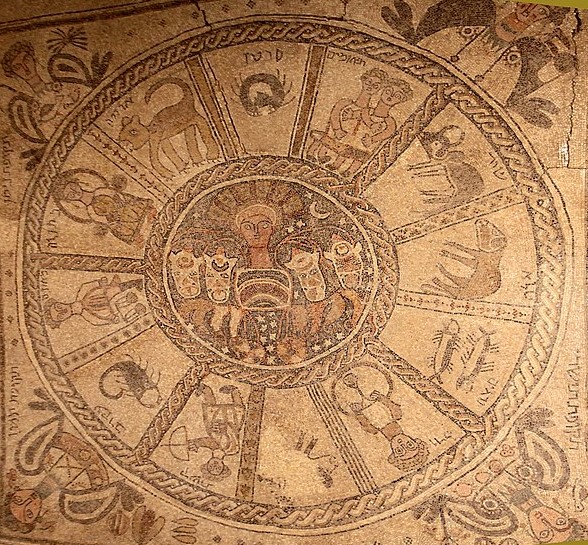
The zodiac was just as important to Jews and Christians as it was to gentile Greeks and Romans. Below is a beautiful mosaic from the Beth Alpha Synagogue of a chariot surrounded by the zodiac.
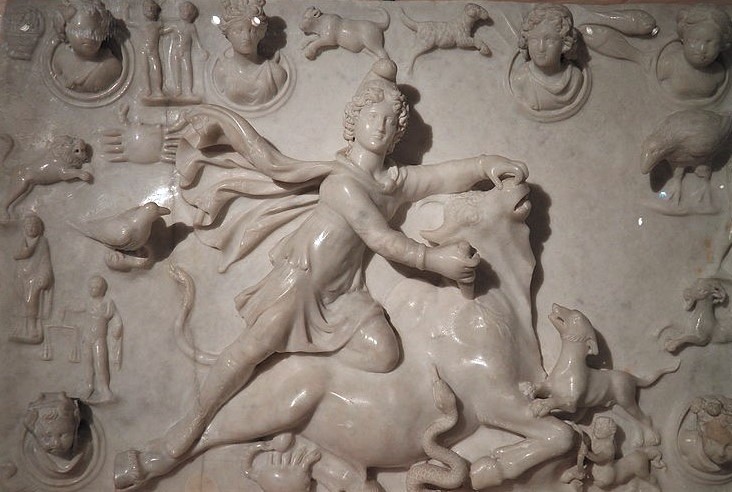
Photo by Carole Raddato. CC BY-SA 2.0
The ancient Greeks had a holistic approach to their view of the universe, and combined astronomy with mathematics, mythology and musical theory. They believed there was a common pattern underlying the whole universe. We see the numbers seven and twelve combined in the chromatic musical scale. There are seven main notes (A – G) on a musical scale, plus five extra pentatonic notes (the black keys on a piano for example). So in total there are twelve notes on the musical scale.
The seven notes were also linked to the ancient cosmology in the idea of the harmony of the spheres. Each of the seven planetary spheres that rotated around the earth in the geocentric model of the universe was believed to make a humming sound that corresponded to each of the seven main musical notes. Cicero mentioned this connection in his Dream of Scipio,
‘”That”, he replied, “is the music of the spheres. They create it by their own motion as they rush upon their way”…Clever men, by imitating these musical effects with their stringed instruments and voices, have given themselves the possibility of eventually returning to this place [the heavenly realm]’ (The Dream of Scipio 18).
 The Bible and Mythology