The motif of the serpent in the tree probably originates in ancient Mesopotamia. We find a possible allusion to it in The Myth of Etana. Tablet II tells of ‘A shrine for Hadad, the god. In the shade of that shrine a poplar was growing. In its crown an eagle settled, a serpent settled at its root’.
We find the same motif in Bilgames [Gilgamesh] and the Netherworld, where we read of a tree in Uruk, ‘In its base a snake-that-knows-no-charm had made its nest, in its branches a thunderbird had hatched its brood, in its trunk a demon-maiden had built her home’ (41-44).
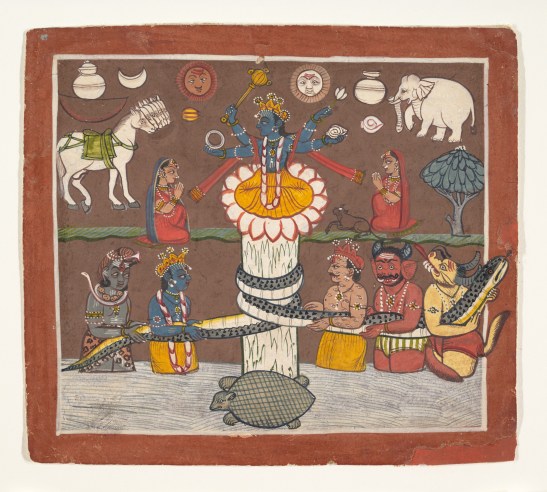
This is very similar to Yggdrasil, the world tree of Norse religion, which also had an eagle perched on its branches and a dragon called Nidhoggr gnawing at its roots. We also find a mythological serpent at the world axis in an Indian creation story. In the Mahabharata, the gods churn the (cosmic) ocean of milk to create the amritra (ambrosia) that guarantees their immortality. They do this by pulling a giant serpent called Vasuki or Ananta around the axial Mount Meru.
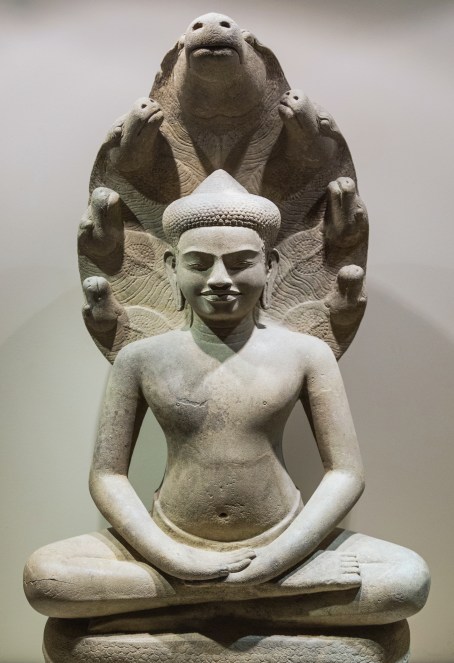
In Buddhism, the Buddha gained enlightenment by sitting under a tree at Bodh Gaya, a place traditionally considered the navel of the earth. Whilst he was meditating, he was protected by Muchalinda, a giant serpent.
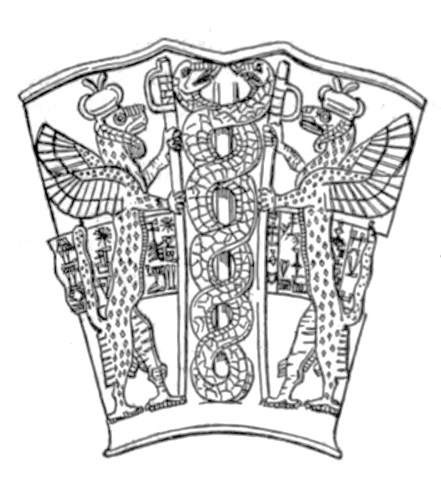
The Sumerians worshipped a god called Ningishzida, who was one of the guardians of the heavenly palace of the supreme sky god Anu. His name means ‘lord of the good tree’ and he was sometimes represented by a snake with a human head. Below is a wraparound of a libation vase dedicated to the god Ningishzida from the 21st century BCE. The motif is clearly similar to the caduceus and the serpent in tree.
The founding of the city of Thebes by Cadmus is another Greek tale with echoes of the Garden of Eden. In Greek mythology, Cadmus was seen as the forefather of the Greeks who founded Thebes under orders from the oracle at Delphi. He was accredited with introducing the Greek alphabet and was the grandfather of Dionysus. Cadmus killed a giant snake against a tree when founding the city of Thebes. The Roman poet Ovid compared this snake to the constellation of Draco,
‘There was an ancient forest which no axe had ever touched, and in the centre of it a cave, overgrown with bushes and branches…hidden in this cave lived the snake of Mars…the snake wound its scaly coils in writhing circles, then with a spring shot up in a huge arc, raising more than half its length in the insubstantial air, until it looked down upon the whole expanse of the forest. It was as the Dragon that twines between the two Bears in the sky, if its full length were seen uncoiled.’ (Metamorpheses 3.28-43)
Cadmus threw a spear at the serpent that pinned it to a tree. Ovid wrote that this spear ‘struck home in a coil in the middle of the creature’s sinuous back: the whole iron blade sank deeply into its belly…an oak tree blocked its backward movement, and its neck was pinned to the trunk.’ (Metamorpheses 3.65-91)
Cadmus was also linked to the creation of men, who rose out of the ground where he planted the dragon’s teeth. We can see a link between his mythology and that of the Garden of Eden. Euripides wrote,
‘Have you no reverence for the gods sir, no piety?
Do you mock Cadmus, who sowed the dragon-seed of earth born men?’ (The Bacchae 263-264)
In The Bacchae, Cadmus is exiled from the city of Thebes by the god Dionysus, as punishment for not worshipping him. Dionysus also turns Cadmus and his wife into snakes.
The motif of the dragon / serpent wrapped around the tree is also found in the story of Jason and the Golden Fleece. Just like with Cadmus, this myth also has a link to the creation of men. Jason sows teeth from the dragon slain by Cadmus using a plough drawn by a pair of fire breathing bronze bulls. Where the dragon’s teeth were sewn, warlike men sprung up out of the soil.
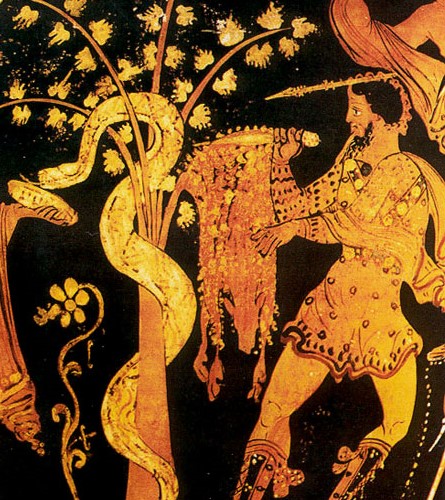
Just like Ladon, the dragon guarding the Golden Fleece was described by ancient sources as being ‘ever wakeful’ (Bibliotheca 1.109) and ‘deathless and unsleeping’ (Argonautica 2.1206). Apollonius Rhodius described the scene with, ‘The fleece is spread on top of an oak, watched over by a serpent, a formidable beast who peers all round and never, night or day, allows sweet sleep to conquer his unblinking eyes’ (Argonautica 2.402).
The Golden Fleece belonged to the ram that was placed in the sky as the constellation Aries, so it seems logical that the serpent wrapped tree it hung from could represent the world axis. It may also have been a golden fleece because the sun rose in Aries at the vernal equinox at the time the myth was created – it was the astrological age of Aries.
This motif of the serpent and the tree was combined in the Greek symbol of the caduceus, the winged staff entwined with two snakes. This wand was carried by the messenger god Hermes, and was specifically linked to his role as psychopompos, or guide of the dead to the afterlife.
The caduceus is probably another symbol of the world axis, the snake-entwined staff representing the snake-entwined pole in the heavens. Asclepius, the Greek god of medicine, was similarly depicted with a snake entwined staff or club.
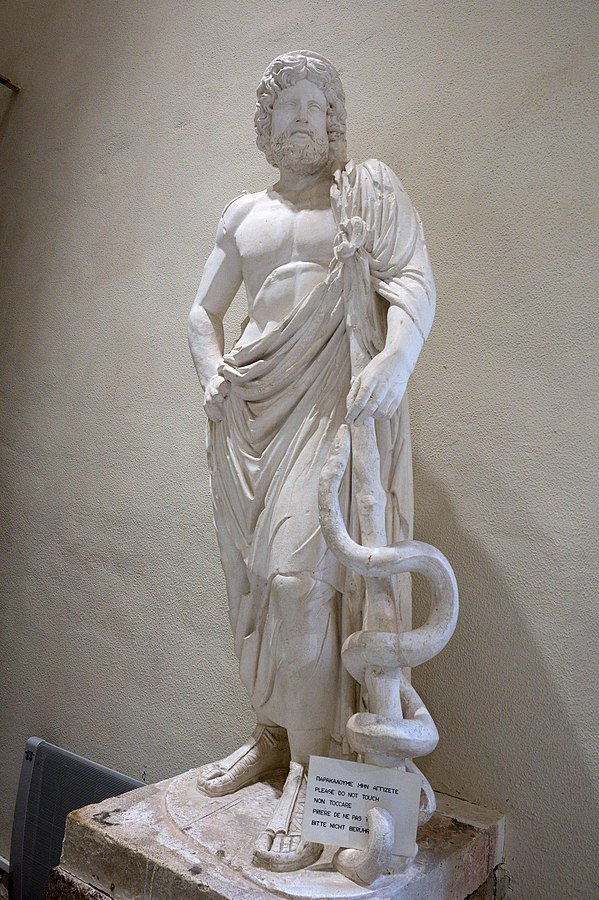
Statues of Apollo and Dionysus, the two gods linked to the omphalos at Delphi, often depicted them next to a tree trunk with a serpent coiled around it.
In many traditions, the route the dead took back to the divine realm after death was via the axis. This may be the reason why Heracles’ eleventh labour was to obtain the apples of the Hesperides, his twelfth was a descent to the underworld to capture Cerberus.
In the Bible we read of Moses’ staff that turn into a snake (Exodus 4.3). The book of Numbers also mentions a bronze serpent on a pole that Yahweh instructs Moses to make (Numbers 21.8-9). The Bible also suggests that the Israelites used to use a bronze snake on a pole as a cult image (2 Kings 18.4).
 The Bible and Mythology