The serpent in the Garden of Eden became associated with the devil / Satan in Christian tradition, and I suspect Satan may have started out as a personification of the constellation Draco, the heavenly dragon. The Book of Revelation states,
‘Then war broke out in heaven, Michael and his angels fought against the dragon. The dragon and his angels fought back, but they weren’t strong enough, and they were forced out of their places in the sky. And the great dragon was thrown down, the serpent of old who is called the devil and Satan, who deceives the whole world. He was thrown down to the earth, and his angels were thrown down with him.’ (Revelation 12.7-9)
Here the devil is expressly called the great dragon in heaven / the sky, i.e. the constellation Draco, and is also linked to the ‘serpent of old’ in the Garden of Eden. We are told that the dragon loses its fight with the angel Michael and is forced from its place in the heavens and thrown down towards earth. The star Thuban in Draco had been the pole star in the third millennium BCE, but was gradually moving away from the pole due to precession. Given the way the ancients viewed the heavens as a dome above the earth, Draco would have appeared to be falling down from the summit of heaven towards the earth.
Although he didn’t understand the cosmology behind the myth, Tertullian (160 – 220 CE) stated, ‘God’s holy mountain, that is to say, in the heights of heaven, from which the Lord testifies that Satan fell’ (Against Marcion 2.10). Hippolytus of Rome (170 – 235 CE) wrote that some early Christians linked the description of Satan in the myth of Job to the constellation Draco,
‘This is what the devil says in the book of Job to the Deity, when (Satan) uses these words: “I have traversed earth under heaven, and have gone around,” [Job 1.7] that is, that I have been turned around, and thereby have been able to survey the worlds. For they suppose that towards the North Pole is situated the Dragon, the Serpent, from the highest pole looking upon all (the objects), and gazing on all the works of creation, in order that nothing of the things that are being made may escape his notice. For though all the stars in the firmament set, the pole of this (luminary) alone never sets, but, careering high above the horizon, surveys and beholds all things, and none of the works of creation, he says, can escape his notice.’ (Refutation of All Heresies 4.47)
There’s also a passage in Ezekiel that may refer to the fall of the serpent from the Garden of Eden. It’s addressed to the King of Tyre, but early Christians took it as referring to Satan. Tertullian stated that, ‘In the person of the prince of Tyre it is said in reference to the devil’ (Against Marcion 2.10). Origen also claimed that the passage actually referred to Satan (Against Celsus 6.44). This makes good sense when we read it,
‘You were in Eden, the garden of God…
…You were anointed as a guardian cherub,
for so I ordained you.
You were on God’s holy mountain.
You walked about in the middle of the fiery stones.
You were perfect in your behaviour from the day you were created,
until sin was discovered in you…
…So I banished you in disgrace from the mountain of God,
and I will destroy you, guardian cherub from the middle of the stones of fire…
…So I threw you to the earth.’ (Ezekiel 28.13-17)
This passage also equates the Garden of Eden to the holy mountain, the classic symbol of the world axis / celestial pole. A first century BCE Jewish text called The Testament of Job also possibly makes a link between Satan and Draco. It describes Satan with, ‘For he has loved the beauty of the serpent and the scales of the dragon, his gall and his venom belongs to the Northern One.’ (The Testament of Job 10.17)
Yahweh is also depicted fighting this dragon in the Old Testament, generally under the names Leviathan or Rahab. This battle may even have been the original creation myth of the Hebrews. The Jewish god was following in the footsteps of other earlier deities who had fought a dragon. In the Babylonian creation myth, Marduk fought and defeated the primeval dragon Tiamat, then split her body in two to create the sky and earth. In the Enuma Elish, Marduk twists and weaves Tiamat’s tail into the durmah (great bond), using this durmah to keep the heavens in place over the earth and Apsu.The durmah sounds like it’s a version of the world axis. Marduk then uses Tiamat’s crotch as a wedge to hoist the heavens upwards and prevent them from falling. There are several serpentine constellations in the sky (Draco, Hydra and Serpens), it’s not impossible that they might originally all have been part of one giant serpent / dragon, stretching from the horizon to the summit of heaven at the celestial pole.
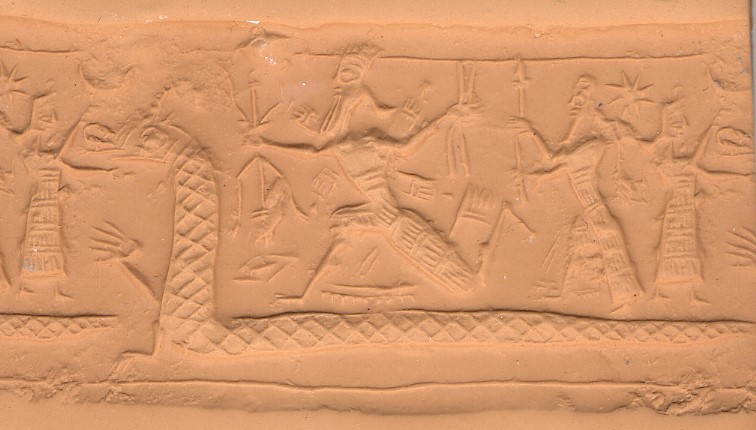
We find the same battle between sky god and dragon in other ancient religions. In Hinduism, Indra fights the dragon Vritra. The Rig Veda predates the Bible and states on Indra, ‘He killed the dragon on the mountain, with roaring thunderbolt’ (Rig Veda 1.32). In a later Indian myth, Krishna climbs a tree before jumping into a river to fight the monstrous serpent Kaliya.
There might also be links to ancient Egypt. the ancient Egyptians equated Baal to their god Set. There are ancient Egyptian depictions of Set stabbing the Apep serpent with a spear as he protects the barque of Re. A mooring post appears by the prow of the boat, possibly representing the pole / axis. Spell 108 of The Ancient Egyptian Book of the Dead also mentions this conflict, ‘As for the mountain of Bakhu on which the sky rests…A serpent is on the top of that mountain…Set will project a lance of iron against him.’ The Book of the Dead describes Apep in very similar language to Tiamat / Lotan, ‘Your serpent foe has been given over to the fire and the rebel serpent is fallen, his arms are bound, Re has taken away his movements’ (Introductory Hymn to Re).
Set may have been linked to the asterism of the Big Dipper, it’s possible that all of the storm gods battling with a serpent may have represented these stars. The Book of Day and Night refers to the asterism of the Big Dipper with, ‘As to this Foreleg of Set, it is in the northern sky, tied to two mooring-posts of flint by a chain of gold. It is entrusted to Isis as a Hippopotamus guarding it.’ The hippopotamus represents the goddess Taweret, linked to circumpolar stars in our constellations of Draco and Bootes, as depicted in the Dendera zodiac. The Dendera zodiac also depicts a falcon wearing a crown in the circumpolar region of the sky, this was a standard representation of Horus. Right by it is an ass like animal that might represent Set.
In Greek mythology, we have similar battles between Zeus and the dragon Typhon and Apollo and the Python at Delphi. There are details in the story of Zeus’ battle with Typhon that might relate to the constellations around the celestial pole. Typhon cut the tendons from Zeus’ hands and feet and hid them in a bear’s skin which was guarded by a dragon called Delphyne.
In the Dionysiaca, Nonnus placed Zeus’ battle with Typhon in the heavens, describing how Typhon attacked the constellations. Nonnus also has Typhon trying to claim Zeus’ throne on Olympus, ‘How long are you going to wait before taking up your quarters in the inaccessible heavens, you sceptred impostor? The throne of Olympus awaits you.’ (Dionysiaca 2.570-2)
The gods that fight the dragons are normally sky / storm gods, just like the biblical god Yahweh. In Hittite mythology, the sky / storm god Tarhuna fought and slew the dragon Illuyanka. In Norse mythology, Thor defeated the Midgard serpent Jormungand. In Roman Germany, we find Jupiter-Giant columns dating to the second and third centuries CE. They depict Jupiter on horseback trampling a prone giant which has snakes for legs, all on top of a tall Corinthian pillar. In Christian tradition, both the angel Michael and St George took on the mantle of fighting the dragon. All of these dragons could represent the constellation Draco, and a battle fought by over the axial peak of heaven.
Yahweh is described smiting this dragon numerous times in some of the oldest parts of the Bible. A good example is in Isaiah,
‘On that day Yahweh with his fierce, great and powerful sword will punish Leviathan the piercing serpent, Leviathan the twisting serpent, he will slay the dragon.’ (Isaiah 27.1)
We find a possible link between this battle and creation mythology in the Psalms,
‘You split open the sea by your power.
You broke the heads of the serpent in the waters.
You crushed the heads of Leviathan…
…You put the moon and sun in place,
you fixed all the regions of the earth,
you created the cycle of summer and winter.’ (Psalm 74.13-17)
The link of the dragon to water may refer to the waters that the Bible writers believed existed above the sky. The book of Job also mentions this battle, as well as mentioning the pillars the ancient Hebrews believed held up the cosmic dome,
‘The pillars of the sky tremble and are amazed at his rebuke.
By his power he churns the sea, by his wisdom he cut Rahab to pieces.
By his breath the skies became fair, his hand pierced the fleeing serpent.’ Job 26.11-13
This motif of Yahweh smiting Leviathan derives from the Canaanite god Baal’s battle with the serpent Lotan, as depicted in the Baal cycle of stories found at Ugarit dating to the 13th century BCE. The very name Leviathan probably derives from Lotan, as may the name Ladon – the dragon who guarded the Garden of the Hesperides. The name ‘Lotan’ means ‘coiled’, which again would link it to Draco and the serpent coiled around the tree. He is also said to have seven heads that might relate to the asterisms of either the Big or Little Dipper, if they were originally conceived as being part of the celestial dragon. Baal is described by,
‘Though you smote Lotan the wriggling serpent,
Finished off the writhing serpent,
Encircler with seven heads,
The skies will be hot, they will shine.’ (CAT 1.5 I.1-4)
In another clay tablet the goddess Anat binds this dragon to the holy mountain, possibly representing the celestial pole,
‘With its tongues it licked the sky,
With its twin tails it turned the sea to foam.
She set the dragon up on high,
She bound it in the heights of [Mount] Lebanon.’ (KTU 1.83R 5-10)
 The Bible and Mythology