Some priests, initiates and believers in the ancient world had visions and practiced ritual ascents to their gods. These ritual ascents were made by pagans, Christians and Jews alike.
By the Roman era, they usually involved complex rituals and magical glyphs and passwords that had to be presented to the archons (a Greek word for heavenly rulers), angels and demons, planets and constellations that would be encountered on the ascent through the cosmos. The literature that survives portrays the cosmic journey in fantastical language, and describes all manner of wondrous heavenly denizens. This tradition is ancient and still survives in Asia, where shamans practice similar ascents to this day.
Several examples of visions and mystical ascents have survived from antiquity, in the biblical tradition these ascents often occur within what’s called apocalyptic literature. The word apocalypse derives from the Greek for ‘lifting of the veil’. It refers to the knowledge gained through mystical visions or ascents, rather than the more modern eschatological meaning of the word. In the Bible, the most famous and influential ascent was that described in Ezekiel. Ezekiel places Yahweh’s throne chariot above the celestial dome. The god is described as follows,
‘Above the dome above their [the Cherubim’s] heads was what looked like a sapphire throne. Upon the throne there was a figure like that of a man. I saw what looked like brass glowing in a furnace from the waist upwards. Below his waist, I saw what looked like fire, and brilliant light surrounded him. Its brightness shone like a rainbow in the clouds on a rainy day. This was how the appearance of the glory of Yahweh looked’ (Ezekiel 1.26-28).
Some of the best examples of ritual ascents to survive from Jewish literature revolve around the biblical figure of Enoch. In these texts, Enoch ascends to the divine realm and is transformed into the chief angel Metatron. Enoch’s apotheosis is described in a similar manner to all the above ascents; his flesh is turned to flame, his veins to fire, his eyelashes become flashes of lightening, and his eyeballs flaming torches.
We also find ritual ascents in an early form of Jewish mysticism, called Merkabah mysticism, which began some time around the third century CE. These Jewish mystics were influenced by the Book of Ezekiel and made their ascent to the chariot throne of Yahweh (called the Merkabah). This throne chariot of Yahweh may have represented Ursa Major. The Babylonians and Greeks called this constellation the Chariot / Wagon, and the Celts also called it the Chariot. Throughout northern Europe it was known as Charles’ Wain (wain is an old fashioned word for chariot). The seven main stars of Ursa Major clearly resemble a wagon or chariot. Hyginus wrote of Ursa Major,
‘The Great Bear is like a wagon…Those who, at the beginning, observed the stars and supposed the number of stars into the several constellations, called this group not “Bear” but “Wain,” because two of the seven stars which seemed of equal size and closest together were considered oxen, and the other five were like the figure of a wagon’ (Astronomica 2.2.2).
The Persians called this constellation haptoiringa – the seven thrones.
The ancient Britons referred to the constellation of Arktos as ‘Arthur’s Chariot’. The very name Arthur probably derives from the ancient British word for ‘bear’, the Welsh word for bear is arth. In the Bible, Yahweh’s throne is placed in the heavens, ‘I saw Yahweh sitting on his throne with all the host of heaven standing on his right and left’ (2 Chronicles 18.18), and ‘Yahweh has established his throne in the heavens’ (Psalm 103.19).
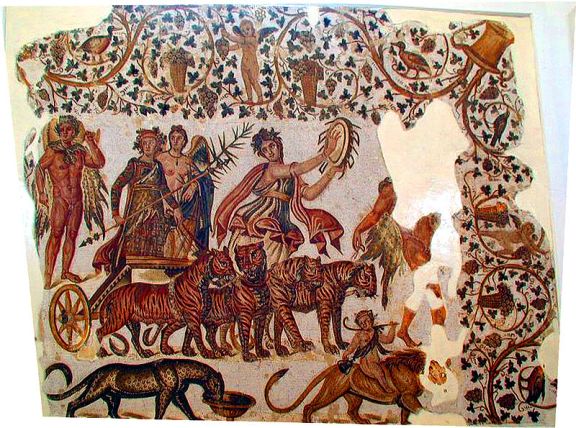
The Greeks also used the motif of the chariot as a vehicle for heavenly ascent. Dionysus ascended to the divine realm in a chariot with his bride Ariadne, and Hercules also ascended to the heavens in a chariot. We also find depictions of an ascent in a quadriga (chariot) in numerous Mithraea. It often follows depictions of initiation into the religion.
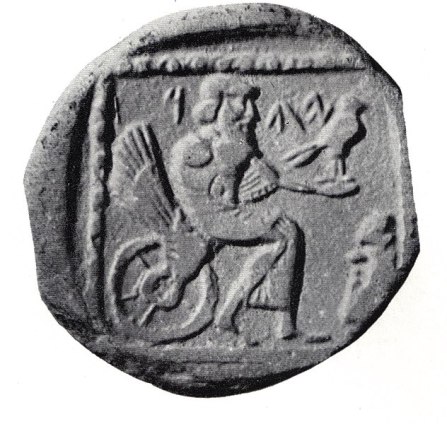
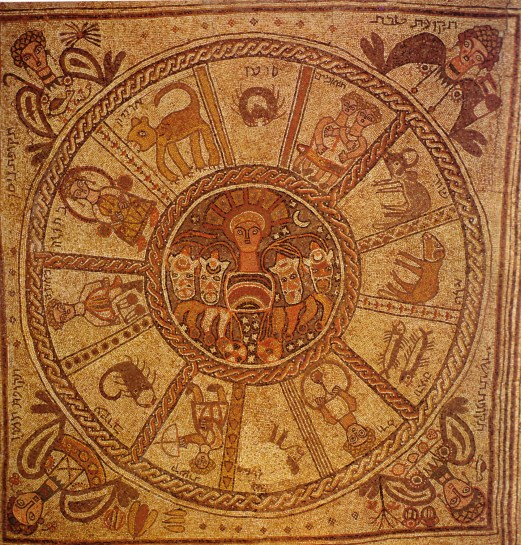
We have Jewish coinage from the 4th century BCE that appears to depict Yahweh sat upon his wheeled chariot throne . This suggests that the Jews were still able to depict Yahweh in human form in the 4th century BCE. The iconography appears to derive from images of Zeus, and in particular his statue at Olympia. There’s also a Roman era Jewish mosaic pavement depicting a chariot at the centre of a zodiacal wheel at Beth Alpha in Israel.
The Merkabah mystics were influenced by the Old Testament book of Ezekiel, which depicts the prophet’s visions of the celestial throne chariot of Yahweh. This chariot contained four heavenly creatures, one had the face of a man, one an eagle, one a lion and one an ox. Ezekiel describes these heavenly denizens with,
‘The appearance of the creatures looked like burning coals of fire, or like torches were darting to and fro among them; the fire was radiant, and lightning flashed from the fire’ (Ezekiel 1.13).
Compare this to the depiction of Yahweh from the Merkabah text called Hekhalot Rabbati (The Greater Palaces),
‘With a gleam of his ray he encompasses the sky
And his splendour radiates from the heights.
Abysses flame from his mouth and firmaments sparkle from his body’ (Hekhalot Rabbati 24)
These descriptions of Yahweh are similar to a description of the Babylonian chief god Marduk in the Enuma Elish, ‘Four were his eyes, four were his ears. Flames shot forth when he moved his lips’ (Enuma Elish I.95-6) . Ezekiel describes the vision of his god beginning with the heavens / sky opening, and ‘a storm wind coming out of the north – a vast cloud with flashing lightning and surrounded by brilliant light’ (Ezekiel 1.4). This could be a reference of the sky / storm god descending from his holy mountain at the north celestial pole.
The Merkabah mystics weren’t only influenced by biblical writings, but also by Hellenistic magic and religion. Their ascents involved the use of Greek passwords in certain rituals, even when the main ritual was performed in Aramaic.
The Merkabah literature describes the mystical ascent in terms of a ladder that bridges interstellar space between the Earth and the seat of Yahweh,
‘Go and bring before me all the heroes of the fellowship, and all the distinguished members of the academy, so that I may tell them the mysteries that are hidden and concealed, the wonders of the weaving of the web on which depends the perfection and glory of the world, the axle of heaven and earth to which the extremities of the earth and the world, and the extremities of the heavens above are bound, sewn and joined, on which they hang and depend, the wonders of the path of the celestial ladder, one end of which rests on earth and the other by the right foot of the Throne of Glory’ (Heikhalot Rabbati 16.1).
We also find the ladder as a symbol of heavenly ascent in Mithraism. A Mithraeum at Ostia contained a mosaic of a ladder. Between each rung were symbols of the seven grades of Mithraism, along with symbols of the planet associated with that grade. Origen wrote of Mithraism in Contra Celsum,
‘Celsus says there is a road for souls to the earth and from the earth that according to Plato is by way of the planets. While Moses, our most ancient prophet, says that a divine vision was presented to the view of our prophet Jacob, — a ladder stretching to heaven, and the angels of God ascending and descending upon it, and the Lord supported upon its top — obscurely pointing, by this matter of the ladder, either to the same truths which Plato had in view, or to something greater than these…In this rite [the initiation rite of Mithras] there is a certain symbol of the two circuits of heaven, the one of the fixed stars and the other that is appointed in turn for the planets and the passage of the soul through them. They picture this as a ladder with seven gates, and at the very top an eighth gate’ (Contra Celsum 6.21-22).
These seven steps or gates on the ladder refer to the seven planets / domes / spheres that had to be encountered on any ascent.
In Merkabah mysticism, the initiate passed through seven palaces to reach the court of Yahweh, mirroring the seven palaces of Osiris that the soul of the deceased had to progress through in The Egyptian Book of the Dead. The Corpus Hermeticum describes the ascent of the philosopher through seven heavenly spheres, where the initiate gives up a vice at each sphere. He lastly reaches the eighth sphere (outer cosmic globe) where he sings hymns to God along with the beings that dwell there.
The Sumerian myth, Inanna’s Descent to the Netherworld has the goddess pass through seven gates on her descent. At each one an item of clothing is removed until she is naked. The myth of Nergal and Erishkigal from Mesopotamia has the sky god An send his messenger Kakka down from heaven to the underworld. He passes through seven gates of the underworld on his descent.
A Sumerian text called The Death of Ur-Nammu states that the dead king ‘presented gifts to the seven chief porters of the Underworld.’ In the Sumerian myth of Gilgamesh and Huwawa (Humbaba), Gilgamesh and Enkidu have to cross seven mountains to reach the mountain of cedar felling that Humbaba lives on. They are guided by seven warriors who are described in one version by the Sumerian word ‘Mul’, meaning ‘stars in the heavens’ or ‘shining in the heavens’.
In Islam, there’s a story of Muhammad’s ascent through the seven heavens. The description of his ascent is very similar to these earlier ones. Muhammad is escorted by the angel Gabriel and passes through gates in seven successive heavens. In each heaven he meets a previous prophet of Islam / figure from the Bible (Adam, Jesus, Joseph, Enoch, Aaron, Moses and Abraham). In the seventh heaven, Muhammad is taken to the Sidrah Al-Muntaha, a giant lote-tree, the Islamic version of the tree of Eden / world tree.
We also find the metaphor of the ladder as the channel between heaven and earth in the Bible, in the dream of Jacob,
‘He [Jacob] dreamt that he saw a ladder, its foundation on earth with its top reaching to heaven, and angels of God were going up and down upon it. And behold Yahweh stood above it’ (Genesis 28.12-13).
This dream occurs at Bethel, which translates as ‘the House of El’ or ‘the House of God’. Bethel is also a variation of the word baetyl, which refers to a sacred stone. In the Book of Genesis, Jacob calls this place ‘the gate of heaven’, and after his dream he sets the stone there as a sacred pillar.
The motif of a ladder as the channel between heaven and earth is an ancient one. The Egyptian Pyramid Texts are the earliest religious literature known, and they mention the dead pharaoh’s ascent to the circumpolar stars using a ladder,
‘The gods who are in the sky are brought to you, the gods who are on earth assemble for you, they place their hands under you, they make a ladder for you that you may ascend on it to the sky, the doors of the sky are opened for you, the doors of the starry firmament are thrown open for you’ (Utterance 572).
Amulets depicting a ladder or a staircase have been found in many Egyptian tombs from the Old and Middle Kingdoms. In Babylonia, the Enuma Elish says of Marduk, ‘Let him take his stand on the heavenly staircase that they may look at him’ (Enuma Elish VII.127).
One of the best illustrations of a ritual ascent from antiquity is from a Roman pagan context, the so-called Mithras Liturgy. This manuscript describes an ascent made by an initiate to see the Roman god Mithras, in which he has to use magical words, glyphs and seals to pass various celestial sentinels en route to heaven. Mithras is described as being located at the celestial pole, holding the bull’s shoulder (the seven stars of the Big Dipper). On his ascent to the pole, the soul first has to pass the ‘seven immortal gods of the cosmos’ and Helios (the Sun).
The following is an extract from the Mithras Liturgy, describing the ascent of the initiate to his god. The passage gives us a good feel for the sort of visionary experience that was at the heart of such ascents, and we can see how similar the language is to Jewish apocalyptic literature.
‘There comes forth seven gods, who have the faces of black bulls, in linen loin cloths, and in possession of seven golden diadems. They are the so-called Pole-Lords of heaven, whom you must greet in the same manner, each of whom with his own name: “Hail, O guardians of the pivot, O sacred and brave youths, who turn at one command the revolving axis of the vault of heaven, who send out thunder and lightning and jolts of earthquakes and thunderbolts against the nations of impious people, but to me, who am pious and god fearing, you send health and soundness of body, and acuteness of hearing and seeing, and calmness in the present good hours of this day, O my Lords and powerfully ruling Gods !”…
…Now when they [the seven Pole Lords] take their place, here and there, in order, look in the air and you will see lightning bolts going down, and lights flashing, and the earth shaking, and a god descending, a god immensely great, having a bright appearance, youthful, golden-haired, with a white tunic and a golden crown and trousers, and holding in his right hand a golden shoulder of a young bull: this is the Bear which moves and turns heaven around, moving upward and downward in accordance with the hour. Then you will see lightning bolts leaping from his eyes and stars from his body’ (The Mithras liturgy 675 – 705).
In Christianity, the cross represented the axial channel between heaven and earth. In the fifth century, Jacob of Sarug described the cross of Jesus as a ladder that leads back to the divine realm,
‘And the mountain became the house of God for Jacob,
and the cross came and stood up in it like a ladder.
The ladder which stood up between heaven and earth,
Is the cross which became an elevator for Adam’s household’ (Homily 135).
Narsai (399 – 502 CE) is one of the most important writers of the Eastern Church, and he likewise wrote,
‘The aged Jacob in the vision saw a ladder
Fixed in earth with its head above in heaven.
This vision is the mystery of the Crucified Man:
By the cross people ascend into high heaven’ (Homily 30).
The Gospel of John has Jesus directly quoting the passage of Genesis that describes the dream of Jacob, with himself as the ladder, ‘You will see heaven open, and the angels of God ascending and descending on the Son of Man’ (John 1.50-51).
Some early Christians performed ritual ascents just like their pagan and Jewish counterparts, and we find references to this practice in the New Testament. In his second letter to the Corinthians, Paul says he knew a Christian (he’s most probably talking about himself) who ‘was caught up as far as the third heaven. And I know that this same man (I don’t know whether in the body or out of it – God knows) was caught up into the Garden of Eden, and heard words so secret that no man may repeat them’ (2 Corinthians 12.2-4).
Most modern Christians won’t understand a word of this, whereas early Christians and initiates of many pagan religions would have been aware that Paul was talking of the third of seven heavens. Paul also mentions the secret passwords and glyphs that allowed the initiate to pass the heavenly guardians and ascend to these celestial realms. The Letter to the Hebrews describes Jesus as having ascended through the heavens, ‘We have a priest who has passed through the heavens, Jesus the son of God’ (Hebrews 4.14).
There’s also a non-canonical Christian text called The Apocalypse of Paul that recounts a mystical ascent of the apostle Paul through each of the heavenly spheres. The Ascension of Isaiah is a second century Jewish-Christian mystical ascent in which the prophet Isaiah is guided through the seven heavens by an angel, who informs him,
‘When I have raised you to the seventh heaven from where I was sent, to that which is above these, then you will know that there is nothing hidden from the thrones and from those who dwell in the heavens and from the angels’ (The Ascension of Isaiah 7.27).
The Ascension of Isaiah also states of Jesus, ‘Those who believe in his cross will be saved, and in his ascension into the seventh heaven from where he came’ (A.o.I. 3.18). The text also mentions the passwords that had to be given to the angels guarding each of the celestial levels, describing Jesus as taking on the form of an angel as he leads Isaiah down through the heavens,
‘And again I saw when he descended into the third heaven, and he made himself into the form of the angels in the third heaven. And those who kept the gate of the (third) heaven demanded the password, and the Lord gave (it) to them in order that he should not be recognized. And when they saw him, they did not praise or laud him, for his form was like their form. And again I saw when he descended into the second heaven, and again he gave the password there; those who kept the gate proceeded to demand and the Lord to give. And I saw when He made himself like unto the form of the angels in the second heaven, and they saw him and they did not praise him, for his form was like their form. And again I saw when he descended into the first heaven, and there also he gave the password to those who kept the gate, and he made himself like the form of the angels who were on the left of that throne, and they neither praised nor lauded him, for his form was like their form. But as for me no one asked me on account of the angel who conducted me’ (The Ascension of Isaiah 10.23-28).
The Testaments of the Twelve Patriarchs is a second century Christian text possibly reusing earlier Jewish material. Part of it describes the ascent of the patriarch Levi through the seven heavens. The early Christian writer Clement Of Alexandria (150 – 215 CE) wrote of, ‘the seven heavens, which some reckon one above the other…the Gnostic [Christian] ought to rise out of the sphere of creation and of sin’ (Stromata 4.25).
Similar ritual ascents still occur today. Siberian nomads look on the central pole in their tents as representing the celestial axis. Their shamans make the ritual ascent to heaven via this central pillar, and this is also the route the dead are believed to take back to heaven. These nomads see the sky as consisting of seven stratified layers, and make their ascent to the ‘seventh sky’. The Yakut shamans of Siberia make the ascent to heaven up a seven layered mountain, at the summit of which is the pole star. The motif of an ascent to the heavenly realm via the world axis might also underpin the story of Jack and the Beanstalk, which is believed to be based on a very ancient motif.
 The Bible and Mythology