Many ancient civilizations believed in a navel or sacred centre, the earthly end of the world axis. For the Sumerians it was Nippur, for the Babylonians it was Babylon, for the Greeks it was Delphi, for the Jews and Christians it’s Jerusalem, for Buddhists it’s Bodh Gaya, and for Muslims it’s Mecca.
One of the earliest sacred centres was Nippur in Sumer (ancient Iraq). It was the most sacred city of the Sumerians, containing the main temple / ziggurat of the sky god Enlil. An ancient Sumerian hymn to Enlil states of Nippur,
‘The mighty lord, the greatest in heaven and earth, the knowledgeable judge, the wise one of wide-ranging wisdom, has taken his seat in the Duranki, and made the Ki-ur, the great place, resplendent with majesty. He has taken up residence in Nippur, the lofty bond between heaven and earth.’
The hymn goes on to claim that the ziggurat of Enlil was the centre of the earth,
‘Enlil, when you marked off holy settlements on earth,
You built Nippur as your very own city,
The ki–ur, the mountain, your pure place, whose water is sweet,
You founded in the Duranki, in the centre of the four corners (of the earth).’
The Duranki was the name of the ziggurat of Enlil, which literally translates as ‘the bond of heaven and earth’, an meaning ‘sky’ and ki being the word for ‘earth’. A Sumerian text called The Song of the Hoe states that Enlil ‘suspended the axis of the world at Duranki’ (The Song of the Hoe 7).
The idea of the main temple of a god being the bond between heaven and earth was replicated elsewhere in the ancient world, including the temple of Yahweh in Jerusalem and the temple of Apollo at Delphi.
The reverence Muslims show towards Mecca is a good example of how important the concept of a sacred centre originally was in each tradition. No matter where they are on the planet, all Muslims pray towards the Kaaba in Mecca. Similarly, all Jews should face Temple Mount in Jerusalem when they pray.
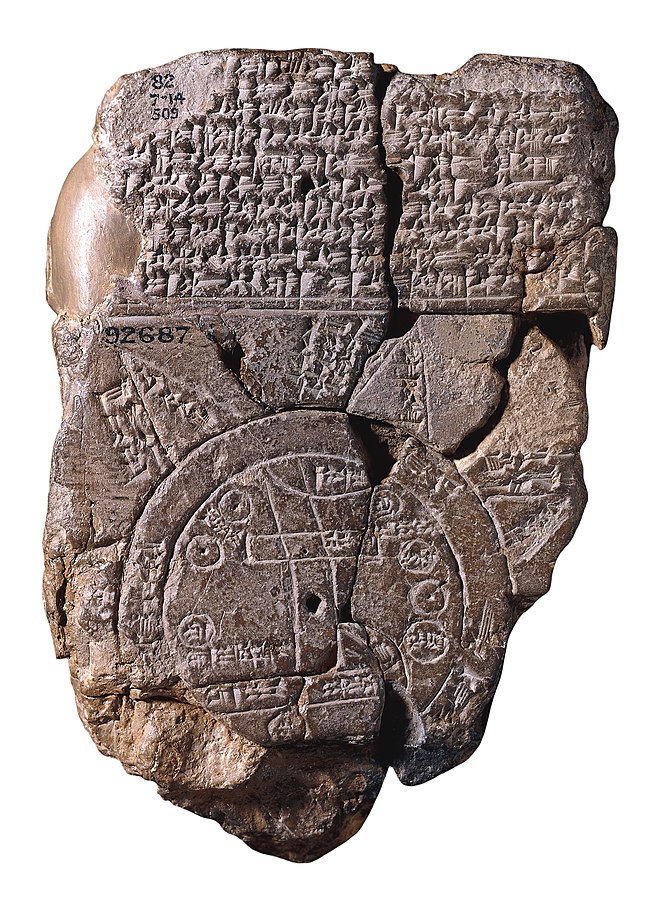
An ancient Babylonian clay tablet depicted the world known to the Babylonians, at its centre was Babylon. The ritual of the new year’s festival at Babylon described the city as, ‘the city of Babylon. In the middle of the earth’ (Temple Program for the New Year’s Festivals at Babylon 64-5).
In medieval times, Europeans thought that Jerusalem was the geographical centre of the earth. You can see this on many mediaeval world maps.

Often the navel of the earth was marked by a sacred stone. In Egypt there was the Benben stone at Innu, in Greece the Omphalos stone at Delphi, in Judaism the Foundation Stone at Jerusalem, in Christianity the Compas within the Shrine of the Holy Sepulchre, and in Islam the Black Stone inside the Kaaba at Mecca. Some of these stones may have been meteorites that had fallen from the sky, the realm of the gods.
Delphi was the sacred centre of the Greek world and was called the Omphalos (which literally means navel). Apollo was the Greek god specifically linked to the navel at Delphi, Euripides wrote about Apollo’s shrine there,
‘This place is Delphi, the centre and navel of the earth; and here Apollo prophesies.’ (Ion 5-6).
The Foundation Stone that’s now inside the Dome of the Rock in Jerusalem was the Jewish equivalent of the omphalos, and was also the location of many biblical events. According to the Babylonian Talmud, this rock was the first part of the world to come into existence, just like the Benben stone in Egypt,
‘Why was it called shetiyya [the Foundation Stone]? It is because the world was created from it…The world was created from its centre’ (Tractate Yoma 54b).
A medieval Jewish text called The Zohar states of the Foundation Stone,
‘The world was not created until Yahweh took a stone called the Foundation Stone and threw it into the depths where it was fixed from above till below, and from it the world expanded. It is the centre point of the world and on this spot stood the Holy of Holies’ (Vayechi 1:231).
Another Jewish text from the early Medieval era, the Midrash Tanchuma, sums up the centrality of the Foundation Stone in Judaism,
‘As the navel is set in the centre of the human body,
so is the land of Israel the navel of the world,
and Jerusalem in the centre of the land of Israel,
and the sanctuary in the centre of Jerusalem,
and the holy place in the centre of the sanctuary,
and the ark in the centre of the holy place,
and the Foundation Stone before the holy place,
because from it the world was founded’ (Midrash Tanchuma, Kedoshim 10).
The Bible places Israel, Judah, Jerusalem and the temple of Yahweh at the centre of the earth. The Book of Exodus has the Jewish god Yahweh state, ‘I am Yahweh in the middle of the earth’ (Exodus 8.22). In Genesis we read, ‘May my name and the names of my fathers Abraham and Isaac grow into a multitude in the middle of the earth’ (Genesis 48.16).
The book of Ezekiel makes it clear the ancient Jews believed Jerusalem was at the centre of the earth, ‘This is what the lord Yahweh says, “This city of Jerusalem I have placed in the centre of the nations”’ (Ezekiel 5.5). The word for middle is normally translated as ‘midst’ in English versions of the Bible, obfuscating its true meaning. Ezekiel likewise describes the Israelites as ‘living at the centre [navel] of the earth’ (Ezekiel 38.12).
The 2nd century BCE Jewish book of Jubilees likewise places the Jerusalem temple at the centre of the world. It has Yahweh say, ‘My sanctuary, which I have hallowed for myself in the middle of the earth.’ (Jubilees 1.10).
The Bible suggests that the area around Shechem may have originally performed this role for the Israelites. The book of Judges states that ‘the navel of the earth’ is close to Shechem (Judges 9.37), and states that there was a ‘great tree’ and a ‘pillar’ there by which kings were crowned (Judges 9.6).
 The Bible and Mythology