The seven books of Deuteronomy, Joshua, 1 and 2 Judges, Samuel and 1 and 2 Kings are called the Deuteronomic ‘history’. They demand strict monotheistic worship of Yahweh and are fiercely intolerant of the worship of other gods. A good example of this can be found in the Book of Deuteronomy,
‘You shall fear the lord your god, serve him alone and take oaths in his name. You must not follow other gods, gods of the people around you. Yahweh your god who is in your midst is a jealous god. If you do, he will be angry with you, and he will destroy you from the face of the earth.’ (Deuteronomy 6.13-15)
These books repeatedly tell stories of how the Israelites prospered when devoting themselves to Yahweh, and puts all their defeats and woes down to them worshipping other deities. It’s believed that the seven Deuteronomic books were originally a separate work from the Pentateuch.
The Deuteronomic books cover the period from the mythical conquest of Canaan to the fall of the fall of the kingdom of Judah and the Babylonian exile. They thus create a second ‘history’ that begins where the books of the Torah end. The books of 1 and 2 Samuel detail stories of the Israelites and king David’s battles against neighbours like the Philistines, Arameans and Ammonites. These look like a continuation of the conquest narrative of Joshua. They claim that the kings David and Solomon ruled over vast swathes of land. 1 Kings states that,
‘Solomon ruled over all the kingdoms from the Euphrates River to the land of the Philistines, as far as the border of Egypt. These countries paid tribute and were Solomon’s subjects all his life.’ (1 Kings 4.21)
There’s absolutely no archaeological evidence to support this claim. David and Solomon aren’t mentioned in any Egyptian or Mesopotamian text. There is also no archaeological evidence in Jerusalem for Solomon’s building projects, including his famous temple of Yahweh described at great length in the Bible. Yet the Bible portrays Solomon as being so important that he married a pharaoh’s daughter (1 Kings 3.1). There’s not even any archaeological evidence that categorically proves David or Solomon ever existed.
Archaeology has shown that Jerusalem and Judah were sparsely populated at the time, even by regional standards, and not the centre of some great empire. The Egyptian pharaoh Shishak conducted a military campaign throughout Palestine in 926 BCE, and nowhere in the account of his campaign is an Israelite or Judean kingdom mentioned. Just like the story of the conquest of Canaan, the stories of David, Solomon’s empire and an original single kingdom worshipping Yahweh were an anachronistic creation.
The biblical authors place the capital of this unified kingdom in Jerusalem. This was the capital of the southern kingdom of Judah, which was far smaller, less important, less populated and less advanced than the northern kingdom of Israel. It seems unlikely any capital of an earlier unified kingdom would have been there.
The books of 1 and 2 Kings and 1 and 2 Chronicles list the kings of the two kingdoms of Israel and Judah. The books give judgements on each king based solely on their religious policies and their obeying the first commandment of worshipping no god other than Yahweh. They show little interest in a ruler’s political or social achievements. They represent intolerant Yahweh worshipping kings (like Hezekiah and Josiah) as models of virtue, and tolerant pluralistic kings (like Ahaz and Manasseh) as bad kings and idolators. Josiah in particular is singled out for praise,
‘Never before nor since had there been a king like Josiah, who turned to Yahweh with all his heart and with all his soul and with all his strength, in accordance with all the Law of Moses.’ (2 Kings 23.25)
Manasseh receives the exact opposite treatment. He was the longest ruling Judean king, and is considered to have been a skilful ruler. He was a loyal vassal of the Assyrians, and this may be partly why the book of Kings portrays him as the most sinful and idolatrous ruler. It goes as far as blaming his idolatry for the eventual fall of Judah (2 Kings 21.1-15), which happened 45 years after his death!
Mostly, the kings of Israel and Judah are said to have done ‘evil in the sight of Yahweh’ (eg 1 Kings 14.22, 2 Kings 8.18). The reason for this is always the same, they were tolerant rulers who allowed the people to worship all the Israelite deities. Ahab (ruled c871-852 BCE) is one king who receives particular abuse,
‘Ahab son of Omri did more evil in the sight of Yahweh than all of those before him. He…began to serve Baal and worship him. He set up an altar for Baal in the temple of Baal that he built in Samaria. Ahab also made an Asherah pole and did more to arouse the anger of Yahweh, the god of Israel, than did all the kings of Israel before him.’ (1 Kings 16.30-33)
Ahab married a Baal worshipping foreigner called Jezebel, and thanks to the slander of the Bible writers, her name became a byword for promiscuity, paganism and prostitution.
One of the central figures in the Deuteronomic books is king Josiah of Judah (ruled c.641 – 609 BCE). The Bible praises him for being a devout Yahwist who aggressively proscribed and persecuted the worship of other gods. To modern eyes he looks like a most unpleasant and intolerant religious fanatic. The book 2 Kings is littered with mentions of his actions against the worship of gods other than Yahweh, in particular the god Baal and goddess Asherah,
‘The king ordered the high priest Hilkiah, the high ranking priests and the guards to remove from the temple of Yahweh all the objects made for Baal and Asherah and all the stars of the sky. He burned them outside Jerusalem in the fields of the Kidron Valley and took the ashes to Bethel. He did away with the idolatrous priests appointed by the kings of Judah to burn incense on the hill shrines of the cities of Judah and on those around Jerusalem, as well as those who burned incense to Baal, to the sun and moon, to the constellations and to all the stars in the sky. He took the Asherah pole from the temple of Yahweh to the Kidron Valley outside Jerusalem and burned it there. He ground it to powder and scattered the dust in the public graveyard. He tore down the houses of the male shrine prostitutes that were in the temple of Yahweh, where women wove hangings for Asherah.’ (2 Kings 23.4-7)
and,
‘Just as he had done at Bethel, Josiah removed all the shrines at the high places that the kings of Israel had built in the towns of Samaria and that had aroused Yahweh’s anger. Josiah slaughtered all the priests of those high places on the altars and burned human bones on them. Then he returned to Jerusalem.’ (2 Kings 23.19-20)
Josiah isn’t the only Yahwist king portrayed as having a lust for the blood of followers of Baal. We’re told that the king Jehu summoned all the priests of Baal to come to the god’s temple in Samaria, then had his soldiers kill them all before destroying the temple (2 Kings 10.18-27). The Book of Deuteronomy repeats this intolerant fanaticism,
‘These are the decrees and laws you must be careful to follow as long as you live in the land that Yahweh, the god of your ancestors, has given you to possess. Destroy completely all the places where the nations you are dispossessing worship their gods – on the high mountains, on the hills and under every leafy tree. Tear down their altars, smash their sacred pillars and burn their sacred Asherah poles in the fire; cut down the idols of their gods and wipe out their names from those places.’ (Deuteronomy 12.1-3)
The Book of Deuteronomy also repeats the edict found elsewhere in the Bible that anyone found worshipping any god other than Yahweh is to be stoned to death (Deuteronomy 17.3-5).
The rules of some of the kings most highly praised by the Bible were actually fairly disastrous for the kingdom of Judah. The Bible describes Hezekiah’s rule with,
‘He did what was right in the sight of Yahweh, according to all that his father David had done. He removed the high places, smashed the sacred pillars and cut down the Asherah poles…He trusted in Yahweh, the god of Israel. There was no one like him among all the kings of Judah, either before him or after him.’ (2 Kings 18.3-5)
Hezekiah rebelled against Assyria and tried to extend the kingdom of Judah into lands of Israel and the Philistines. He was defeated by king Sennecherib of Assyria who laid siege to Jerusalem in 701 BCE. The Bible makes the ridiculous claim that an angel of Yahweh struck 185,000 Assyrians dead and forced them to retreat from Jerusalem (2 Kings 19.35). An inscription from Nineveh recounts the reality that Sennecherib annexed parts of Judah and exacted a large tribute from Hezekiah before withdrawing back to Assyria.
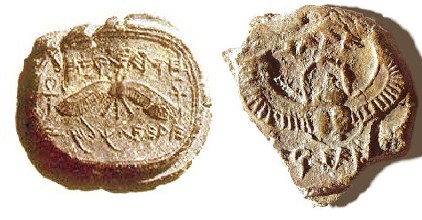
The Deuteronomic ‘history’ of ‘good’ and ‘bad’ kings may actually be a later invention of the Babylonian or Persian periods. Hezekiah is one of the kings most singled out for praise as a strict Yahweh worshipper intolerant of ‘foreign’ gods, yet the archaeological evidence suggests this may not have been the case. Archaeologists have discovered two royal seals of Hezekiah, and they show a strong Egyptian influence on that king. One depicts a winged disc with two ankhs (the Egyptian symbol of life), the other depicts a winged scarab beetle. We wouldn’t expect to see this clear foreign influence if the biblical depiction of Hezekiah was true.
One of the chief narratives of Deuteronomy is that the ‘good’ kings destroyed the temples outside of Jerusalem and concentrated worship of Yahweh at his temple in Jerusalem. Once again, archaeology suggests this may not have been the case. It may represent the reality of a later period when the narrative was written. Archaeologists have discovered an Iron Age temple at Tel Motza, five kilometres outside Jerusalem, which dates to the period of the kingdom of Judah.
Clay human figurines were found at the temple, possibly anthropomorphic representations of god(s), maybe even Yahweh himself. The temple existed throughout the period of the monarchy and was finally abandoned during the Persian period. We also have the evidence of the 5th century BCE temple of Yahweh in Elephantine, Egypt. Jews there worshipped Yahweh alongside other gods, and don’t appear to have used or even known of the Jewish Bible. Josephus also wrote that there was a Jewish temple to Yahweh at Leontopolis in Egypt, built in the second century BCE (Antiquity of the Jews 8.3).
The books also mention prophets of Yahweh who admonish unfaithful kings, and attribute fantastical myths to these prophets. One has to wonder if these prophets were real or are mythical creations. The most famous prophet mentioned is probably Elijah. The name Elijah literally means ‘My god is Yahweh’, which seems rather suspicious. Given that the Bible claims that Elijah brought a boy back from the dead (1 Kings 17.19-22), and called fire down from the sky (1 Kings 18.36-38), I’m inclined to think Elijah is a mythical figure. Just like Moses, Joshua and favoured kings like Josiah, the supposedly holy man Elijah turns out to be a murderous religious fanatic. He demands that 450 priests of Baal are murdered simply for following another deity (1 Kings 18.40).
Elijah is followed by Elisha, whose name means ‘my god is salvation’, which again suggests he may be a fictional character. Once again he performs the miracle of bringing a boy back from the dead (2 Kings 4.33-35). Elisha is portrayed as another irascible figure, the Bible tells us of a bizarre story where he summons two bears to maul 42 boys who were calling him ‘baldy’! (2 Kings 2.23-24). The fact that there aren’t any books or writings attributed to Elijah and Elisha elsewhere in the Jewish Bible also suggests they are fictional figures.
Some, if not the majority of the Deuteronomical text, dates to the Babylonian captivity or the Persian period. Deuteronomy specifically mentions the devastation of the land (Deuteronomy 29.22-8), suggesting it was written after the fall of the kingdom of Judah in 587 BCE. The Deuteronomical narrative continually blames the worship of other gods for the disasters that befell Israel and Judah,
‘They went and worshipped other gods and bowed down to them…That is why Yahweh’s anger erupted against this land, so that he brought on it all the curses written in this scroll. In furious anger and great rage, Yahweh has uprooted them from their land and deported them to another land, as it is now.’ (Deuteronomy 29.26-8)
The Deuteronomical narrative singles out the kingdom of Israel in particular for straying from the worship of Yahweh. This may be because it was written by Judeans. The two kingdoms weren’t always allies, 1 Kings tells us of wars they fought against each other (1 Kings 15.17). Israel was larger and more advanced than Judah, so it may also be that it was also more cosmopolitan and open to foreign gods. In 2 Kings the Deuteronomical writers blame the Assyrian invasion of Israel on the Israelites worshipping gods other than Yahweh,
‘The king of Assyria invaded the entire land, marched against Samaria and laid siege to it for three years. In the ninth year of Hoshea, the king of Assyria captured Samaria and deported the Israelites to Assyria…All this took place because the Israelites had sinned against Yahweh their god…They worshipped other gods.’ (2 Kings 17.5-7)
The Book of Deuteronomy lists in graphic detail all the terrible things that will happen to the Israelites and Judeans should they disobey the laws of Yahweh and his king and priests. They include disease, dysentery, drought, starvation, plague, boils, haemorrhoids, madness, blindness, having their wives raped, being made the slave of foreigners and eating the flesh of their own children (Deuteronomy 28).
The Judeans and Israelites must have been at a loss as how to explain how insignificant and minor their kingdoms were, sometimes being vassal states of the major powers of the day – Egypt, Assyria, Babylon, then later Persia, Greece and Rome. All this despite them being the chosen people of the supposedly most powerful god Yahweh. The bizarre and twisted explanation for this ended up being that their sin and unfaithfulness to Yahweh had resulted in him punishing them and favouring other nations that didn’t even worship or recognise him.
The Book of Esdras (Ezra) even goes so far as to claim that the revered king Josiah was killed in battle by the Egyptians because he disregarded what Yahweh’s prophet Jeremiah had told him (1 Esdras 1.25-31). Esdras also claims that the Babylonian conquest of Judah and subsequent captivity was Yahweh’s punishment for their impiety. Yahweh even ordained the destruction of his own temple in Jerusalem and the slaughter of all the priests within it (1 Esdras 1.50-57). The Book of 2 Esdras openly questions Yahweh and quite why his chosen people have had to suffer at the hands of the gentile nations,
‘Of all the countless nations, you have adopted one for your own, and to this chosen people you have given the law that all men have approved. Why then Lord have you put this one nation at the mercy of so many? Why have you humiliated them more than all others, and scattered your own people among the hordes of the heathen? Those who reject your promises have trampled on the people who trust your covenants. If you hate your people, they should be punished by your own hand.’ (2 Esdras 5.27-30)
This explanation for the Jews’ defeat and exile became the defining theme of the Jewish Bible. We repeatedly encounter it in the books written during and after the Babylonian exile. The idea that a god’s displeasure was the reason for calamities appears to have been a common feature of Near Eastern thought. On the 9th century BCE Mesha stele, king Mesha of the neighbouring kingdom of Moab gives the same explanation for Israel attacking his land, ‘Omri was king of Israel and he oppressed Moab for many days because [the god] Kemosh was angry with his land’ (Mesha Stele line 5).
We also find the same mentality in far earlier texts from the Near East. The Cursing of Akkad is a late third millennium BCE text depicting the city of Akkad’s destruction by the Gutians. It states that the god Enlil brought about this invasion of foreigners because of a violation of his temple by an Akkadian king (The cursing of Akkad 149-175).
The Lament for Sumer and Ur similarly makes the claim that Enlil brought about the invasion and destruction of Sumer. It states, ‘Enlil brought down the Elamites, the enemy, from the highlands’ (The Lament for Sumer and Ur 166). Just like the Judeans over a millennium later, the Sumerians came to the conclusion that their god(s) had been responsible for a foreign invading army that destroyed their cities and even the gods’ own temples.
This whole narrative of accusing the Israelites and Judeans of being unfaithful to Yahweh came back to haunt later Jews when it was used in anti-Jewish polemic by early Christians. The Christians blamed the Jews for killing humanity’s saviour and the son of their own god, viewing them as a people that had continually disobeyed Yahweh and ignored his prophets throughout their history. Origen (184 – 253 CE) wrote of the Jews,
‘But when it became necessary for them, as a nation wholly given to sin, to be brought back by their sufferings to their god, they were abandoned [by him], sometimes for a longer, sometimes for a shorter period. Until in the time of the Romans, having committed the greatest of sins in putting Jesus to death, they were completely deserted.’ (Against Celsus 4.32)
 The Bible and Mythology