Numerous Christian authors from the third and fourth century onwards made the connection between the crucifixion, Golgotha and Adam. The church father Origen (185 – 254 CE) wrote,
‘I have received a tradition to the effect that the body of Adam, the first man, was buried upon the spot where Christ was crucified.’ (Commentary on Matthew 126)
Athanasius (296 – 373) stated that the crucifixion happened ‘in the Place of a Skull which the Hebrew teachers declare was Adam’s sepulchre.’ Epiphanius (310 – 403), wrote that ‘Our lord Jesus Christ was crucified at Golgotha, in no other place than that in which Adam lay buried.’ Basil of Caesarea (330 – 379) and John Chrysostom (347 – 407) both also said that the crucifixion happened on the burial site of Adam.
The letters of Paul are believed to be the earliest known Christian writings. They make a clear connection between the fall of humanity via Adam and the redemption gained through Jesus’ crucifixion and resurrection. This association was central to his creed. Paul wrote,
‘Just as it was a man who brought death into the world, so a man also brought resurrection of the dead. As in Adam all men die, so in Christ all will be raised to life.’ (1 Corinthians 15.21-22)
While there’s no obvious allusion to this connection in the gospels, the location of the crucifixion on Mount Golgotha could possibly link it to Adam. ‘Golgotha’ translates as ‘the Place of the Skull’ (Matthew 27.33). The name Golgotha appears in all four gospels, so it was clearly an important part of the Jesus story. In Christian tradition, the name Golgotha took its name from the skull of Adam. The crucifixion was believed to have taken place at the exact location that Adam had been buried.
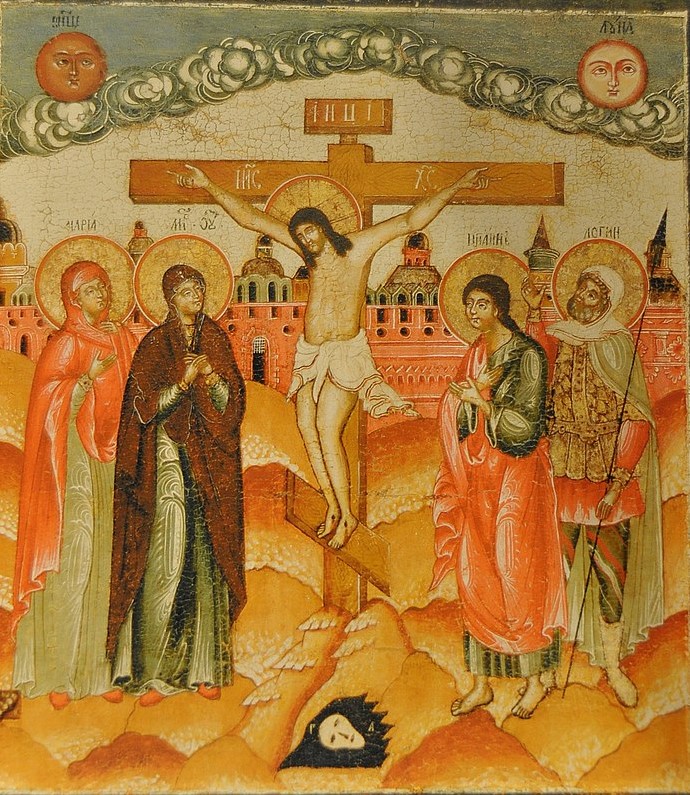
Many mediaeval depictions of the crucifixion in both Catholic and Orthodox art depict the skull of Adam below the cross. The blood of Jesus shed during his suffering supposedly washed away the sin of Adam, the crucifixion thus redeeming the original fall of man. Today, the rock of Golgotha can be found inside the Church of the Holy Sepulchre. Directly beneath the rock is the Chapel of Adam, traditionally marking the place where the first man was buried.
Paul never specifically places the crucifixion at Jerusalem, that may have been a later addition by the gospel writers. A line from the Psalms may have influenced this decision, ‘And God is my king of old, working salvation in the middle of the earth.’ (Psalm 74.12)
The Bible places Israel, Judah, Jerusalem and the temple of Yahweh at the centre of the earth. The Book of Exodus has the Jewish god Yahweh state, ‘I am Yahweh in the middle of the earth’ (Exodus 8.22). In Genesis we read, ‘May my name and the names of my fathers Abraham and Isaac grow into a multitude in the middle of the earth’ (Genesis 48.16).
The book of Ezekiel makes it clear the ancient Jews believed Jerusalem was at the centre of the earth, ‘This is what the lord Yahweh says, “This city of Jerusalem I have placed in the centre of the nations”’ (Ezekiel 5.5). The word for middle is normally translated as ‘midst’ in English versions of the Bible, obfuscating its true meaning. Ezekiel likewise describes the Israelites as ‘living at the centre [navel] of the earth’ (Ezekiel 38.12).
Later Christians viewed the site of the crucifixion as the centre of the earth. A fourth century text from Pseudo-Hippolytus described the cross with,
‘This tree, wide as the heavens itself, has grown up into heaven from the earth. It is an immortal growth and towers between heaven and earth. It is the fulcrum of all things and the place where they are at rest. It is the foundation of the round world, the centre of the cosmos.’ (De Pascha Homilia 6)
Cyril of Jerusalem (315 – 386 CE) stated,
‘God stretched forth his hands upon the cross in order to embrace the farthest limits of the earth, for this hill of Golgotha is the centre of the earth. It is not my word, but it is a prophet who has said, “You have wrought salvation in the middle of the earth” [Psalm 74.12].’ (Catechesis 13.28)
A third century Christian poem also notes the location of Jesus’ crucifixion,
‘There is a place we believe to be the centre of the world
The Jews give it the native name of Golgotha.’ (Pseudo-Cyprian – De Ligno Vitae)
Located within the Church of the Holy Sepulchre is the Compas, a marble vase believed for centuries to have marked the exact centre of the world, just like the omphalos stone at Delphi. Several mediaeval Christian pilgrims to Jerusalem noted that they were visiting the place they believed to be the centre of the earth. In 690 CE, a Frankish bishop called Arculf wrote,
‘But God, our king, before the ages has wrought salvation in the middle of the earth, that is, in Jerusalem, which, being in the middle, is also called the navel of the earth.’ (Arculf – The Pilgrimage of Arculfus in the Holy Land)
In the twelfth century, Saewulf visited the Church of the Holy Sepulchre, and stated,
‘At the head of the Church of the Holy Sepulchre, in the wall outside, not far from the place called Calvary, is the place called the Compas, which our Lord Jesus Christ himself signified and measured with his own hands as the middle of the world.’

Numerous later texts accentuate the link between Jesus and Adam in Christian tradition. The sixth century Book of Adam and Eve has the dying Adam inform his son Seth,
‘For the place where my body will be laid is the centre of the earth and from there God will come to redeem all our race.’
And,
‘Into the land whither we go the Logos of God will descend, and he will live there, and in the place where my body lies he will be crucified, so that he will sprinkle my head with his blood.’
Another sixth century apocryphal Christian text called The Cave of Treasures, similarly states,
‘And when he [Adam] rose at full length and stood upright in the centre of the earth, he planted his two feet on that spot whereon was set up the cross of our redeemer, for Adam was created in Jerusalem.’ (The Cave of Treasures II.12-16)
Elsewhere in The Cave of Treasures, Yahweh tells Adam that he will one day send his son down from heaven to redeem humanity at the centre of the earth, at the exact spot where Adam is buried,
‘In as much as you have transgressed my commandments be gone, but be not sad. After the fulfilment of the times which I have allotted that you will be in exile outside [Paradise], in the land which is under the curse, behold, I will send my son. And he shall go down [from heaven] for your redemption, and he shall sojourn in a virgin, and shall put on a body [of flesh], and through him redemption and a return shall be effected for you. But command your sons, and order them to embalm your body after death with myrrh, cassia, and stakte. And they shall place you in this cave, wherein I am making you to dwell this day, until the time when your expulsion shall take place from the regions of Paradise to that earth which is outside it. And whosoever shall be left in those days shall take your body with him, and shall deposit it on the spot which I shall show him, in the centre of the earth; for in that place shall redemption be effected for you and all your children.’ (The Cave of Treasures p67-8)
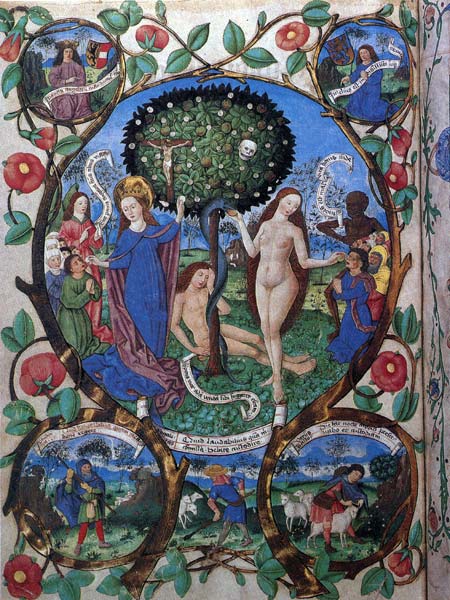
Christian tradition also came to see the cross and the Tree of Life in the Garden of Eden as one and the same, the fall and redemption of mankind thus occurring at precisely the same location. Ephrem the Syrian (306 – 373 CE) noted,
‘Greatly saddened was the Tree of Life
when it beheld Adam stolen away from it;
it sank down into the virgin ground and was hidden
to burst forth and reappear on Golgotha.’ (Hymns of Virginity XV.10)
Jacob of Sarug (451 – 521 CE) wrote,
‘At the beginning sin killed Adam by the wood,
so too the Son of God killed sin by the wood.
The Tree of Life abolished the Tree of Knowledge.’ (Homily 53)
The Cave of Treasures also notes this association,
‘This tree of life in the middle of paradise is a prefiguration of the redeeming cross which is the true tree of life, and this cross was set up in the centre of the earth.’ (The Cave of Treasures IV.3)
There’s a famous fresco in Arezzo (Italy), called The Discovery of the True Cross, in which the wood from the Tree of Eden is reused for the cross of Jesus. This connection between Adam, the Tree of Eden and the crucifixion was often represented in mediaeval art.
Some Christians created an even closer link between Adam and Jesus. Both are supposed to have died at exactly the same hour on exactly the same day of the year. The Cave of Treasures notes this connection,
‘And the departure of Adam from this world took place…on the fourteenth day of the moon, on the sixth day of the month of Nîsân, at the ninth hour, on the day of the Eve of the Sabbath [i.e. Friday]. At the same hour in which the Son of Man delivered up his soul to His Father on the Cross, did our father Adam deliver up his soul to Him that fashioned him; and he departed from this world.’ (The Cave of Treasures VI.17-18)
According to many early Christian sources, Jesus wasn’t actually crucified, but was hung from a tree. The first letter of Peter states that, ‘He himself bore our sins in his body on the tree’ (1 Peter 2.24).
Two Greek words appear in the New Testament to describe the cross of Jesus. They are stauros, which translates as pole or stake, and xulon, which translates as wood or tree. The word xulon is exactly the same word used in the Septuagint to describe the tree of knowledge in the Garden of Eden. Hippolytus of Rome (170 – 236 CE) stated that Jesus was ‘nailed to the tree by the Jews’ (On Psalm 2).
Mythologically speaking, crucifixion and hanging from a tree could represent the same thing. Some early Christian texts juxtapose Jesus crucified with Jesus nailed to a tree. In the Bible, we read in Acts, ‘He was put to death by hanging on a tree’ (Acts 10.40). The non-canonical Gospel of Truth states,
‘He was nailed to a tree (and) he became a fruit of the knowledge of the Father.’ (Gospel of Truth 18.24-5)
And,
‘He was nailed to a tree; he published the edict of the Father on the cross.’ (Gospel of Truth 20.25-7)
Similarly we read in The Second Treatise of the Great Seth,
‘And the world became poor when he was restrained with a multitude of fetters. They nailed him to the tree, and they fixed him with four nails of brass.’ (Second Treatise of the Great Seth 58.22-26)
The Letter of Peter to Philip likewise notes,
‘Our illuminator, Jesus, came down and was crucified. And he bore a crown of thorns. And he put on a purple garment. And he was [crucified] on a tree and he was buried in a tomb. And he rose from the dead.’ (Letter of Peter to Philip 139.15-20)
The Testaments of the Twelve Patriarchs states that Jesus, ‘shall be lifted up upon a tree’ (Testaments of the Twelve Patriarchs 12.9). The Ascension of Isaiah is a second century Jewish-Christian text that recounts the crucifixion in cosmic language, having Jesus descend from ‘the seventh heaven’,
‘The going forth of the beloved [Jesus] from the seventh heaven had been made known, and his transformation and his descent and the likeness into which he should be transformed (that is) the likeness of man…and he should before the sabbath be crucified on the tree.’ (Ascension of Isaiah 3.13)
We also find a link in the gospels between Jesus’ crucifixion and the Old Testament story of the bronze serpent on a pole raised by Moses in the wilderness. The Gospel of John has Jesus say, ‘Just as Moses lifted up the snake in the wilderness, so the Son of Man must be lifted up, so that everyone who believes may have eternal life’ (John 3.14-15). The serpent on a pole is probably a symbol of the world axis and the constellation Draco that entwines it.
If we view the fall of Adam and the Garden of Eden as a myth about the fall of human souls from the heavenly realm into the earthly realm via the world axis, then we could view the crucifixion as a myth about the reopening of the axis to allow the return of souls to the heavenly realm.
Lines from the Old Testament were used to create the gospel narrative about Jesus. The specific idea of a crucifixion may have originated in the Psalms. Psalm 22.16 reads, ‘Dogs surround me, a pack of villains surrounds me. They pierce my hands and my feet.’ Deuteronomy 21.23 may also have been the inspiration. Paul related the crucifixion back to this line when he wrote, ‘Christ redeemed us from the curse of the law by becoming an accursed thing, for it is written: “Cursed is everyone who is hung on a tree”’ (Galatians 3.13).
Many of the details of the crucifixion as it’s described in the gospels derive from the Old Testament, in particular Isaiah 53 and Psalm 22. Matthew 27.34 states that Jesus was given wine mixed with gall to drink at Golgotha. That was added to the story to correlate to a line in Psalm 69.21, ‘They put gall in my food and gave me vinegar for my thirst.’
The same thing is true for the casting of lots for Jesus’ clothes (Matthew 27.35). That was added to accord with Psalm 22.18, ‘They divide my clothes among them and cast lots for my garments.’ The Gospel of John specifically quotes the Old Testament passage when mentioning this event (John 19.24).
Jesus being mocked on the cross derives from Psalm 22.7, ‘All who see me mock me. They sneer, shaking their heads.’ The Gospel of Matthew even has these mockers wagging their heads (Matthew 27.39). The very words the mockers utter probably also derives from Psalm 22. Matthew has them say, ‘He trusted in God; let him deliver him now, if he will have him: for he said, I am the Son of God.’ (Matthew 27.43). Psalm 22.8 reads, “He trusts in Yahweh,” they say, “let Yahweh rescue him. Let Yahweh deliver him.”’
Jesus’ last words are also directly lifted from Psalm 22. Psalm 22.1 reads, ‘My god, my god, why have you forsaken me?’ Mark 15.33 has Jesus repeat this exact formula. The Gospel of John adds a detail of Jesus being pierced by a lance while on the cross, and that detail was probably inspired by Zechariah 12.10, ‘They shall look on me, the one who they have pierced,’ as well as Isaiah 53.5, ‘he was pierced for our transgressions.’
The darkness that supposedly spread across the land at the time of the crucifixion (Matthew 27.45), was mirroring a line of prophecy from Amos relating to the final Day of Judgement, ‘”In that day,” says the lord Yahweh, “I will make the sun set at noon and make the earth dark in the middle of the day’ (Amos 8.9). Joel likewise described this day with, ‘For the day of Yahweh is coming. It is near— a day of darkness and gloom, a day of clouds and blackness’ (Joel 1.1-2).
 The Bible and Mythology