Christianity could be viewed as a product of the Hellenising of Judaism. Greek was the main language of the Eastern Mediterranean in Roman times, and many Jews of the period were thoroughly Hellenised. Even the Jewish heartland of Judea became Hellenised. The temple of Yahweh that Herod built in Jerusalem was constructed in a Greek architectural style.
Most Jews of the Diaspora outside of Judea were fully Hellenised. Greek was generally their first language, and they used the Septuagint (the Greek version of the Hebrew Bible). It’s this version that is quoted by the writers of the New Testament.
Philo (20 BCE – 50 CE) is the classic example of the Hellenised Jew from this period. He was a Jewish philosopher who lived in Alexandria and wrote treatises that interpreted the Jewish Bible allegorically through the use of Platonic, Stoic and Pythagorean philosophy. Philo was a Greek speaker, and didn’t speak either Hebrew or Aramaic. His thought combined Greek and Jewish traditions, just like Christianity.
Paul is the earliest Christian author we know of, and he is another example of a first century Hellenised Jew. Paul’s first language was Greek, and his epistles only quote from the Greek version of the Old Testament, not the Hebrew one. He also uses Greek theological terms such as pneuma (spirit), gnosis (divine knowledge), sophia (wisdom) and teleioi (the initiated).
Christianity may well have been created by Hellenised Jews like Paul who spoke Greek, read Greek literature and philosophy, and used the Septuagint. The figure of Jesus combined the Jewish concepts of the Messiah and Son of Man with the Greek ideas of saviour and son of god.
The gospels have Jesus coming to Jerusalem from Nazareth, which was in Galilee. Galilee was heavily Hellenised, there were twelve Greek cities within a 25 mile radius of Nazareth in the first century CE. Rabbis were later to call it the ‘district of the gentiles.’ Palestine itself was also Hellenised in this period, it’s been estimated that there were 35 Hellenistic cities in Palestine in the first century CE.
Looking at the historical and literary evidence, the New Testament makes most sense if one accepts that the original language of Christianity was most probably Greek, not Aramaic or Hebrew. The earliest known letters and gospels are all written in Greek.
When the writers of the New Testament quote from the Old Testament, they invariably quote from the Greek version and not the Hebrew one. Augustine wrote of it, ‘The Church has received this Septuagint translation just as if it were the only one, and it has been used by the Greek Christian people, most of whom are unaware that there is any other’ (City of God 18.43).
The gospels even have Jesus quoting the Septuagint, sometimes in most unlikely situations, such as Mark 7. In this verse, Jesus quotes the Greek version of Isaiah 29.13 in an argument with the Pharisees in Jerusalem (Mark 7.6-8). Luke also has Jesus quote the Septuagint to Jews in the synagogue at Nazareth (Luke 4.16-19).
Maybe Christianity began with a group of Hellenised Jews who wanted to free themselves of the restrictive laws of the Torah (Old Testament). Or maybe they wanted to create a new form of Judaism that would appeal to non-Jews. We know that Christianity actively proselytized from the outset. By removing circumcision and restrictive elements of the Torah, such as the food laws and sabbath observance, Christianity could appeal to many more Gentile converts than Judaism ever could. One of the New Testament letters suggests this may have been the view of its author,
‘He has made the two [Gentiles and Jews] one and has destroyed the enmity which stood like a barrier between them in his body of flesh. He abolished the law with its rules and regulations.’ (Ephesians 2.14-15)
Circumcision in particular was viewed as a cruel abhorrence by many pagans. By removing it Christianity automatically appealed to many more potential converts. In the first century, Philo wrote that, ‘the ordinance of circumcision of the parts of generation is ridiculed.’ (The Special Laws I). There is evidence that numerous Roman women converted to Judaism, but the very act of circumcision may have prevented men from doing the same. A 2013 study of the mitochondrial DNA of Ashkenazi Jews concluded that up to 81% of them were ultimately descended from female European converts to Judaism who married Jewish men from the Near East. Only 8% were descended from women from the Near East.
Paul’s letters are believed to be the earliest Christian documents we know of. Paul makes it clear in those letters that his mission was to convert gentiles to worshipping Yahweh. He wrote, ‘But when God…chose to reveal his son through me, so that I might proclaim him among the gentiles’ (Galatians 1.15-16), and, ‘He redeemed us so the blessing of Abraham would come to the gentiles through Jesus Christ.’ (Galatians 3.14)
Many of the earliest converts to Christianity were Greek speaking gentiles and not Jews. Most of the church fathers were members of other mystery religions and philosophical schools before becoming Christians. This was noted by Justin Martyr in the second century,
‘The Christians from among the Gentiles are both more numerous and more true than those from among the Jews and Samaritans.’ (First Apology 53)
The Christian writer Clement of Alexandria (150 – 215 CE) implied that he saw Christianity as a fusion of Greek and Jewish thought,
‘To the Jews belonged the law, and to the Greeks philosophy, until the advent [of Jesus]. After that came the universal calling to be a peculiar people of righteousness. Through the teaching that flows from faith brought together by one lord, the only god of both Greeks and barbarians.’ (Stromata 6.17)
Titles given to Jesus such as the Son of God, the Good Shepherd, the Logos and the Fisher of Men were all applied to Greek gods and saviours such as Dionysus, Hermes and Attis before Jesus. The central tenet of Christianity is that Jesus is the Son of Yahweh. In Greek religion sons of god such as Dionysus, Hercules, Asclepius and Perseus were important religious figures.
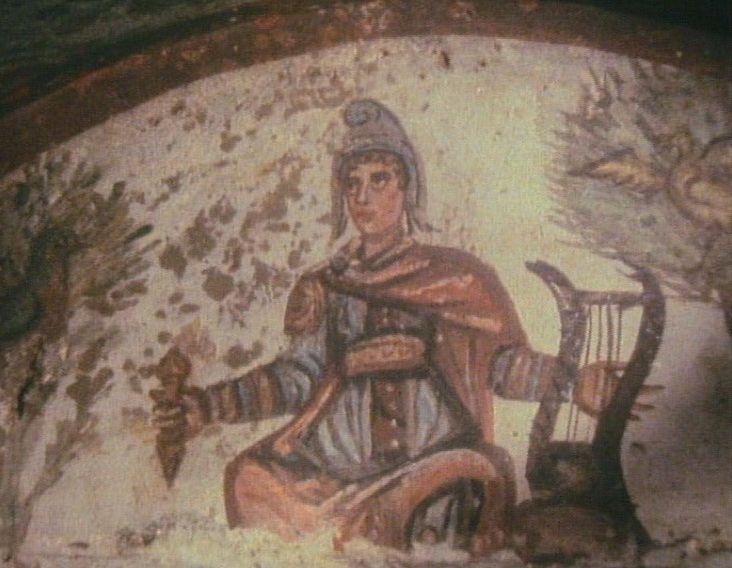
Orpheus was one such figure who became closely associated with Jesus. The earliest religious iconography of Jesus depicted him as either a pagan god or a Greek philosopher. Jesus was depicted as Orpheus playing the lyre, as the Good Shepherd, copying earlier images of Hermes Kriophoros, as and as Helios is his sun chariot. The earliest known crucifixion scene dates to the fifth century, and the crucifixion only became the iconic Christian symbol at a much later date than that.
Dionysus was an important son of god and saviour in the Greek world who has similarities with Jesus. His virgin mother was miraculously impregnated by the king of the gods. Both Orpheus and Dionysus were associated with the Greek concept of the Logos, as were the gods Apollo, Hermes, and Sabazius. Jesus was given the title of Logos in the Gospel of John (John 1.14), and many early Christians referred to him by that name.
The word Logos is translated as the ‘the Word’ in the English version of the New Testament. This is because it was translated as verbum in the Latin versions, which translates as ‘word’. The Logos was a Greek concept, and can also be translated as thought, reason, myth, story, logic and ratio.
Hermes was the god most associated with the concept of the Logos in the ancient world. Early church fathers knew the Greek ancestry of the term Logos, Hippolytus (170 – 236 CE) wrote that Mercurius verbum esse traditus – ‘It is said that Mercury is the Word [Logos].’ Elsewhere in the Greek world, an inscription from a sanctuary of Dionysus at Halicarnassus implored the reader to join the rites ‘in order that you may know the whole Logos’.
Christianity not only borrowed some of its theology from Hellenistic religion, some of its morality is very similar to Greek philosophy. Several philosophers, including Plato, taught a creed of non retaliation, as well as rejecting material acquisition. The early pagan critics of Christianity were also aware of the similarity between the teachings of Jesus and Greek philosophy. Celsus wrote,
‘You Christians have a saying that goes something like this: “Don’t resist a man who insults you; even if he strikes you, offer him the other cheek as well”. This is nothing new, and it’s been better said by others, especially by Plato.’ (Origen – Against Celsus 7.58)
Some early Christians also noted the similarities between Christianity and Greek philosophy and mythology. The Christian apologist Justin Martyr wrote,
‘As to the objection of our Jesus being crucified, I say that suffering was common to all the aforementioned sons of Jupiter…As to his being born of a virgin, you have your Perseus to balance that. As to his curing the lame, and the paralytic, and such as were cripples from birth, this is little more than what you say of your Asclepius’ (First Apology 22)
and
‘In saying all these things were made in this beautiful order by God, what do we seem to say more than Plato? When we teach a general Conflagration, what do we teach more than the Stoics? By opposing the worship of the works of men’s hands, we concur with Menander, the comedian; and by declaring the Logos, the first begotten of God, our master Jesus Christ, to be born of a virgin, without any human mixture, to be crucified and dead, and to have risen again, and ascended into heaven: we say no more in this, than what you say of those you style the sons of Jupiter.’ (First Apology 21)
The teachings ascribed to Jesus in the gospels are often noticeably different to the demands of Yahweh and Moses in the Old Testament. In particular, they completely lack the intolerance towards other gods and hatred of idolatry that are probably the most salient feature of the Old Testament. Yahweh is repeatedly described in the Old Testament as being a jealous and vengeful god, paranoid about the Jews worshipping any deity other than him. The Book of Nahum states,
‘Yahweh is a jealous and vengeful god;
Yahweh takes vengeance and is full of anger.’ (Nahum 1.2)
Some early Christians noted this difference, the most famous was Marcion (110 – 160 CE). Marcion went so far as to believe that Christianity was in direct opposition to Judaism, and his followers mockingly named the Jewish god Yaltabaoth.
Marcion considered the god of the Old Testament to be a wrathful and genocidal deity, and not the father of Jesus. He described the Christian god as being ‘placid, mild and simply good and excellent’, compared to the Jewish god who was ‘lustful for war, inconsistent in his attitudes and self-contradictory’.
Marcion produced a text called The Antitheses which juxtaposed quotes from the Old and New Testaments showing how the teachings contradict one another, and in his opinion weren’t the handiwork of the same deity.
There were other early Christians that we call ‘Gnostic’ who also believed that the god that fathered Jesus and the Jewish god were two entirely different entities. A good example of this can be found in The Second Treatise of the Great Seth, which describes Yahweh as being merely an archon (a heavenly ruler) and a ‘laughing stock’,
‘For the Archon was a laughing stock because he said, “I am God, and there is none greater than I. I alone am the Father, the Lord, and there is no other beside me. I am a jealous God, who brings the sins of the fathers upon the children for three and four generations.”’ (The Second Treatise of the Great Seth 64.18-65.1)
Plato and some other Greek philosophers taught that a god by nature should be perfect and good. Yahweh of the Old Testament was clearly far from this paradigm with his intolerance, anger and jealousy. This was a huge problem for some early Christians like Marcion.
Pagans also noted the distinct contrast between the teachings of the god of Christianity and the god of Judaism. Celsus wrote,
‘The Jews teach God’s vengeance on their enemies, but Jesus advises that someone who has been struck should volunteer to be hit again. Well, who is to be disbelieved – Moses or Jesus? Perhaps there is a simpler solution: perhaps when the Father sent Jesus he had forgotten the commandments he gave to Moses.’ (Origen – Against Celsus 7.43)
Christianity came into existence at a difficult time in Roman-Jewish relations. The Jews revolted against their Roman rulers in 66 CE and a war was fought between the Roman Empire and Judea for four years until Rome triumphed, resulting in the sack of Jerusalem and the destruction of the temple of Yahweh in 70 CE.
Once again the Jews were left pondering how they had been defeated by gentiles who supposedly worshipped false gods, when they believed they were the chosen people of the one true god. The standard explanation from the Bible would be that they must have sinned and offended Yahweh to have brought about such a catastrophe. The soul searching that followed this defeat may have profoundly affected early Christianity.
 The Bible and Mythology