As viewed from the earth, all the stars in the night sky appear to revolve around one pivotal point, the celestial pole. This is the extension of the earth’s North Pole into space. It’s at the centre of the whole celestial dance, and is thus the logical seat for the conductor.
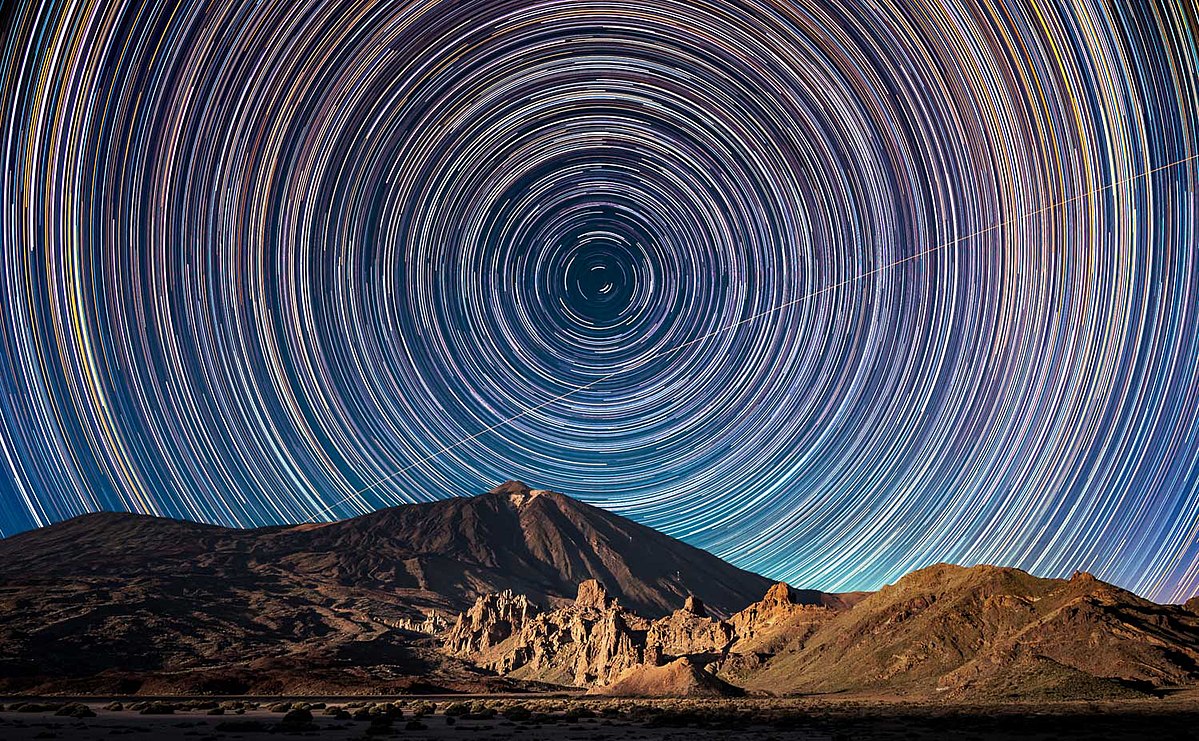
Due to precession (that’s the technical term for the wobble of the earth’s axis), the exact location of the pole in the heavens changes over long periods of time. At the moment, the pole is covered by the pole star Polaris in Ursa Minor, but this hasn’t always been the case. 4500 years ago when the pyramids of Giza were built, the pole star was Thuban in the constellation Draco.
The constellations found in the polar regions (the snake / dragon Draco and the bears Ursa Major and Ursa Minor) have often been seen as symbols of the rotation of the heavens and the divine force believed to be behind it. A Greek magical papyrus addressed the constellation Ursa Major with the words,
‘Bear, Bear, you who rule the heaven, the stars and the whole world; you who make the axis turn and control the whole cosmic system and compulsion; I appeal to you!’ (Greek Magical Papyri 7.880-81).
We also possibly find a reference to the biblical god Yahweh linked to the pole in the Book of Job, ‘Surely God is at the zenith of the sky and looks down on all the stars, high as they are’ (Job 22.12).

The celestial pole was also represented in an earthly sense by the navel of the world. The ancients believed the universe was turned by an invisible axis, which ran between the pole star (the centre of the sky) and the navel (the centre of the earth). This central axis of the universe is usually called the world axis (or axis mundi). An excellent description of this comes from Manilus (first century CE),
‘Now where heaven reaches its culmination in the shining Bears, which from the zenith of the sky look down upon all the stars and know no setting and, shifting their opposed stations about the same high point, set sky and stars in rotation, and from there an insubstantial axis runs down through the wintry air and controls the universe, keeping it pivoted at opposite poles it forms the middle about which the starry sphere revolves and wheels its heavenly flight, but is itself without motion and, drawn straight through the very globe of the earth, stands fixed’ (Astronomica 1.280-1).
In the third century BCE, the Greek poet Aratus of Soli described the world axis with,
‘They [the stars], all alike, many though they be…are drawn across the heavens always through all time continually. But the axis shifts not a bit, but unchanging is forever fixed, and in the middle it holds the earth in equipoise, and wheels the heaven itself around…On either side the axis ends in two poles, but of them one is not seen, whereas the other faces us in the north high above the ocean. Encompassing it two bears wheel together, why they are also called the wain [wagon]…Between them, as if it was the branch of a river, circles the dragon in a wondrous way, winding infinite around and about’ (Phaenomena 19-47).
 The Bible and Mythology